
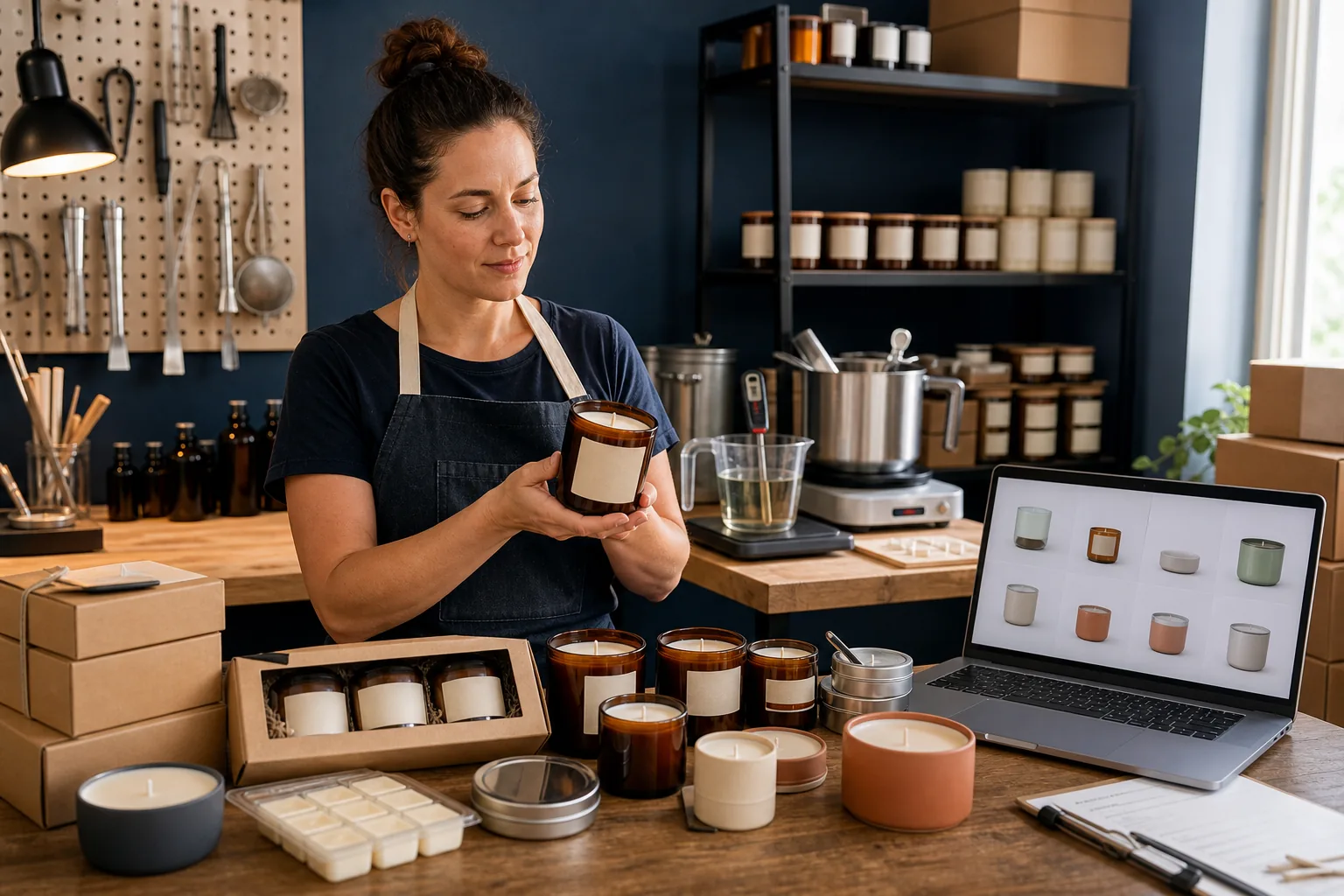
To sell handmade candles online successfully, test the exact candle system, document ingredients and batches, explain scent and product specifications without unsupported claims, show the vessel and scale accurately, price testing and breakage, plan for heat and seasonal demand, package against leakage and impact, and connect each order to safe production and fulfillment procedures.
The short answer: sell a tested system, not a fragrance idea
A candle is the interaction of wax, fragrance, color, wick, vessel, fill weight, manufacturing process, cure, burn environment, and user behavior. A maker should not assume that a wick that worked in one jar will work in a different diameter, wax, fragrance load, or production batch.
Online, customers cannot smell the product or inspect the vessel. The listing must communicate scent character, strength without guarantees, size, materials, expected burn behavior, care, safety, production time, packaging, and what happens if the shipment arrives damaged.
A beautiful storefront cannot substitute for a tested candle, an appropriate warning label, and a traceable production record.
1. Decide what kind of candle business is going online
| Offer type | Customer expectation | Useful online workflow |
|---|---|---|
| Ready-to-ship candles | Receive a stocked scent and vessel quickly | Standard product page, tracked inventory, and checkout |
| Made-to-order candles | Choose from defined scents, vessels, or labels and wait for production | Controlled variants with production and cure timing |
| Seasonal collections | Purchase a limited release during a known window | Launch calendar, controlled quantities, and clear restock status |
| Gift sets | Send a coordinated, gift-ready package | Defined contents, packaging, message, and shipping options |
| Subscriptions | Receive candles on a recurring schedule | Subscription application, renewal policy, inventory, and fulfillment capacity |
| Wholesale or custom-label work | Order business quantities, packaging, or an approved custom program | Inquiry, feasibility, samples, quote, approval, and invoice |
A shop can support several models, but each creates different inventory, cash-flow, labeling, testing, shipping, and customer-service obligations. Start with the model the business can operate consistently.
2. Build testing and safety into the product
The U.S. Consumer Product Safety Commission's current candle business guidance identifies requirements involving lead in metal-cored wicks and hazardous-substance cautionary labeling. It also points businesses to industry consensus standards covering candle terminology, fire-safety labeling, glass containers, visible emissions, candle fire safety, and candle accessories.
Review the current standards, applicable federal, state, local, and destination requirements, supplier documentation, insurance expectations, and qualified professional guidance. This article is operational guidance, not a testing protocol or legal opinion.
A documented test program should control:
- Exact wax, additive, dye, fragrance, wick, tab, adhesive, vessel, lid, and supplier
- Vessel dimensions, material, batch, condition, and intended candle use
- Formula percentages, measured weights, temperatures, mixing, pouring, cooling, and cure
- Wick position, trimming, mushrooming, flame behavior, melt pool, soot, smoke, and vessel temperature
- Burn intervals, environment, candle placement, drafts, and stop conditions
- Total burn behavior and remaining-wax limits
- Failure, corrective change, retest, and approval records
- Label, warning, instructions, packaging, and traceability
Changing fragrance, load, dye, wick, wax, jar geometry, supplier, or process can change performance. Define which changes require a new test series. Do not use customer feedback as the primary safety test.
3. Build a focused collection from approved formulas
Begin with candles the business has fully tested, costed, labeled, photographed, and packaged. A smaller collection reduces the number of combinations that must be sourced, tested, stocked, and supported.
Useful collection paths
- By scent family: Woody, fresh, floral, citrus, herbal, gourmand, unscented, or another understandable structure
- By format: Container candles, tins, wax melts, travel sizes, gift sets, or accessories that are themselves evaluated appropriately
- By use case: Everyday, gifts, housewarming, seasonal, weddings, client gifts, or self-care without medical promises
- By release: Core collection, limited seasonal release, small batch, archive, or upcoming restock
- By size: Only when each vessel size has its own tested formula and wick system
A fragrance name can be creative, but it should not hide what the product smells like. Pair it with a plain-language scent description and recognizable notes. Avoid using names or packaging that imply another brand, copyrighted character, food product, or unsafe intended use.
4. Give each candle page complete product information
Every candle listing should address:
- Product type, wax or blend, wick type, vessel material, lid, and relevant components
- Net weight, vessel dimensions, wick count, and approximate product scale
- Scent family, top-middle-base style description where useful, and whether the product is unscented
- Expected burn-time range based on the tested product and stated use—not an unsupported maximum
- Initial and repeat burn instructions, wick trimming, placement, supervision, and stop-use guidance
- Applicable warning information in both product and packaging contexts
- Whether the item is ready to ship or made to order
- Production, cure, processing, and carrier-transit timing
- Expected appearance variation such as frosting, surface change, color shift, adhesion, or handmade variation
- Packaging, gifting, included items, and whether prices appear in the shipment
- Warm-weather shipping rules, address limits, and damage-report process
- Cancellation, return, exchange, replacement, and subscription terms
Shopify's current product-details guidance specifically uses candle burn time as an example of specialized information that can be stored in product metafields. A published burn-time range should come from the business's test evidence and clearly stated conditions.
5. Organize scents, sizes, vessels, and options carefully
Shopify's current variant guidance explains that combinations such as size or color can be separate variants with their own inventory. Candle variants might include a tested vessel size, finish, or scent within a tightly related product family.
Do not combine unrelated formulas merely to make the catalog look smaller. Separate products may be clearer when scents need different stories, ingredients, colors, test results, photographs, prices, warning considerations, or availability.
Use variants only for supported combinations
- Each vessel size should have its own tested wax-wick-fragrance system.
- Each scent should use a tested load and appropriate wick configuration.
- Inventory should reflect the exact finished product or the limiting component.
- Variant imagery should show meaningful vessel or color differences accurately.
- Option names should remain clear in the cart, notification, packing record, and batch-picking workflow.
Personalized labels, gift messages, event dates, or custom packaging normally require suitable fields or a separate inquiry. Do not let a free-text box create an unreviewed labeling or intellectual-property problem.
6. Make wax, fragrance, environmental, and wellness claims supportable
Candle marketing often uses words such as natural, clean, non-toxic, eco-friendly, sustainable, chemical-free, pet safe, child safe, therapeutic, aromatherapy, soot free, smoke free, long lasting, or biodegradable. These claims can create expectations the maker may not be able to prove.
Document before describing
- Wax or blend identity and supplier documentation
- Fragrance and dye information relevant to the intended candle use
- Wick construction and supplier
- Vessel, lid, label, adhesive, packaging, and accessory materials
- Country of origin and manufacturing facts behind any origin claim
- Testing behind burn time, emissions, performance, safety, or comparative claims
- Evidence and conditions behind recycled, recyclable, compostable, reusable, or plastic-free claims
Do not imply that a scented candle treats anxiety, improves sleep, purifies air, removes toxins, protects health, or is safe around every person or animal without qualified substantiation and an understanding of applicable rules. Fragrance preferences and sensitivities vary; provide accurate information and a practical support path.
Decorative botanicals, crystals, glitter, embeds, vessel coatings, toppings, and accessories can affect fire behavior. Appearance is not a safety justification. Evaluate the complete finished product and current requirements before sale.
7. Photograph the candle accurately and safely
Customers need to understand the vessel, wax color, label, scale, lid, packaging, and gift presentation. Use a consistent primary image, alternate angles, a scale reference, a top view, a label and warning view, packaging, and a lifestyle context that does not model unsafe burning.
If showing a lit candle, depict it upright on a stable, heat-resistant surface, away from flammable objects, drafts, children, and pets, and within an attended context. Do not place flames beside dried flowers, books, curtains, bedding, packaging, or crowded décor.
Editing should not misrepresent jar color, fill level, wax finish, flame size, packaging, or included contents. State when natural wax appearance or handmade batches can vary. Avoid using smoke effects or oversized flames for drama.
8. Price testing, waste, packaging, and risk
A sustainable candle price can include:
- Wax, fragrance, dye, wick, tab, adhesive, vessel, lid, label, and warning label
- Inbound freight, supplier minimums, breakage, component variation, and storage
- Formula development, burn tests, test vessels, failed versions, and documentation
- Weighing, melting, mixing, pouring, cooling, curing, trimming, cleaning, and labeling labor
- Batch quality control, retain samples, records, and rework
- Gift boxes, inserts, cushioning, outer mailers, tape, and shipping preparation
- Warm-weather holds, reshipments, damage replacements, and customer support
- Shopify, payment processing, applications, subscription costs, discounts, and returns
- Equipment, studio, ventilation, utilities, insurance, professional advice, overhead, risk, and profit
Track actual batch yield and labor. Wax left in equipment, spilled fragrance, broken jars, off-center wicks, failed labels, and test units are real costs.
Gift sets and wholesale pricing should include extra assembly, packaging, sorting, labeling, samples, and communication. A high quantity does not automatically reduce cost when the order adds custom labels, multiple scents, individual addresses, or a firm event date.
9. Track formulas, components, finished goods, and batches
| Inventory layer | What the business needs to know |
|---|---|
| Raw materials | Supplier, item, lot or batch, quantity, receipt date, storage, and documentation |
| Packaging components | Vessels, lids, labels, warning labels, boxes, inserts, and damage rate |
| Work in process | Poured date, cure status, formula, batch, quantity, and release date |
| Finished inventory | Exact scent, vessel, size, batch, inspection, and sellable quantity |
| Production capacity | Melting, pouring, cooling, curing, labeling, storage, packing, and labor limits |
Assign a batch identifier that connects the finished candle to ingredients, suppliers, process, test-approved formula, production date, inspection, and destination orders. Decide how long to retain records and samples based on qualified advice and the business's risk plan.
Shopify can track finished variants, but it does not automatically understand that several products share the same wax, fragrance, jar, lid, or maker capacity without a compatible application or manual system.
10. Plan launches around cure time and seasonal demand
Candle demand can concentrate around fall, winter holidays, gifting, weddings, and corporate events. Build a calendar backward from the customer delivery date:
- Formula confirmation and required testing
- Component ordering and supplier buffer
- Production, cooling, cure, inspection, and labeling
- Photography, listing, and launch content
- Wholesale or gift-set approval
- Order cutoff, packing, carrier acceptance, and transit buffer
- Replacement capacity before the event or holiday
Do not launch more seasonal scents than the business can test, photograph, store, and fulfill. Archive discontinued products clearly rather than leaving misleading restock expectations. If preorders fund a production run, disclose the conditions, timeline, cancellation terms, and risk accurately.
11. Package for glass, wax, heat, leakage, and presentation
A candle shipment may face drops, crushing, vibration, heat, cold, and long carrier delays. Test the complete package with the actual vessel, lid, label, gift box, cushioning, and outer container.
Shipping controls to define
- Individual protection between glass or ceramic vessels
- Secure lids and barriers against scuffs, dust, and leakage
- Cushioning and void fill that survive realistic handling
- Outer-box strength, sealed edges, and readable shipping label
- Warm-weather shipping days, holds, expedited options, and destination limits
- Cold-weather appearance changes and acclimation guidance when relevant
- Carrier restrictions, declared value, tracking, and insurance
- Gift messages, price omission, and multi-address rules
- Damage-report deadline, required photographs, and replacement process
Do not make universal melting or temperature guarantees without evidence. Climate, carrier handling, package exposure, vehicle temperature, vessel, wax, and delivery timing vary. A hold-for-cooler-weather or limited shipping schedule can be better than promising impossible protection.
12. Write returns, replacements, and support policies for candles
Candles can arrive broken, melt, show cosmetic variation, smell different than expected, or perform poorly because of product, environment, or use. The policy should separate preference, normal variation, transit damage, defect, and safety concern.
Questions to answer
- Can unopened candles be returned or exchanged?
- How are used candles handled when the issue is scent preference?
- What evidence is needed for broken glass, leakage, or other shipping damage?
- What wax appearance changes are normal and which indicate a problem?
- How should a customer report unusual flame, smoke, vessel, or wick behavior?
- When should use stop immediately?
- Does the business replace, refund, or investigate a suspected defect?
- How are gift, limited, custom-label, wholesale, or subscription products treated?
- What happens when a package is delayed, refused, undeliverable, or left in heat?
Maintain an escalation and incident-record process. Safety complaints should not be handled as ordinary review management. Preserve relevant batch, order, communication, and sample information and seek appropriate professional guidance.
13. Give wholesale, weddings, and custom-label orders a separate path
Retailers, corporate gifts, weddings, hospitality, subscription boxes, and events may require:
- Approved candle formulas, scent assortment, vessel, size, and quantity
- Minimums, price tiers, samples, and production capacity
- Label dimensions, supplied artwork, required warnings, brand approval, and rights
- Packaging, inserts, barcodes, case packs, displays, and line sheets
- One destination versus individual gift shipping
- Purchase order, tax status, payment, cancellation, and reorder terms
- Production, cure, packing, transit, and in-hands deadlines
A custom label does not remove the candle maker's responsibility for the underlying product and applicable labeling. Do not cover, shrink, or redesign required information without confirming compliance.
Use an inquiry, written specification, sample approval, quote, and invoice for complex work. Define who owns custom artwork and leftover components, and what happens when the client changes the design or quantity after materials are ordered.
14. Add subscriptions only after repeat fulfillment works
Shopify's current subscription guidance says recurring purchase options can be offered through its first-party Shopify Subscriptions application or compatible third-party applications. Customers can manage payment, address, pause, skip, and cancellation options through supported account experiences.
A subscription is an operating commitment, not simply a recurring revenue switch. Confirm:
- Whether customers receive a fixed scent, choose each cycle, or get a curated release
- Price, billing date, frequency, shipping charge, discount, and tax behavior
- Inventory reservation and substitution rules
- Cutoff dates for skip, pause, address change, scent choice, or cancellation
- Failed-payment, sold-out, damaged, delayed, and discontinued-product procedures
- Margin after recurring packaging, shipping, application, support, and churn costs
- Capacity to test and produce every promised monthly or seasonal item
Subscription setup and ongoing management are outside Overtime Innovations' standard free build scope.
15. Connect the order to one traceable production record
The batch and fulfillment records together should identify:
- Product, scent, vessel, size, formula version, and approved test record
- Ingredient, wick, vessel, lid, label, and packaging suppliers and lots
- Measured weights, temperatures, process steps, dates, operators, yield, and loss
- Cooling, cure, release, inspection, and label status
- Finished batch identifier and exact quantities
- Quality checks for vessel condition, wick placement, fill, surface, adhesion, label, warning, lid, and packaging
- Order, customer, gift service, subscription, carrier, tracking, and ship date
- Deviation, hold, rework, disposal, complaint, and corrective-action information
Define cleaning, contamination prevention, fragrance handling, heat protection, ventilation, storage, spill response, equipment maintenance, and worker procedures for the actual studio. Obtain appropriate safety data and professional guidance.
Do not release a batch merely because an order deadline is near. If a component, process, or result differs from the approved system, place the batch on hold until it is evaluated.
16. Market scent, occasion, and experience without unsafe promises
Customers may search by scent family, room, season, gift, vessel style, location, ingredient preference, or occasion. Build useful collections and content around supported customer questions.
Potential content topics
- How to choose a candle scent online
- Understanding candle size, net weight, and expected burn time
- How to trim and care for a candle wick
- Why a candle's first burn matters
- How seasonal candle launches are planned
- What frosting or surface variation means for the actual wax used
- Gift-set and corporate-order timelines
- How the studio tests vessel and wick combinations
- How candle subscriptions work
- Behind-the-scenes batch and quality-control stories without revealing unsupported secrets or claims
Marketplaces, craft fairs, wholesale partners, local pickup, social media, email, referrals, and search can feed an independent store. Follow marketplace rules when communicating with marketplace customers.
Measure qualified traffic, product views, conversion, average order value, margin, damage, replacements, repeat purchase, subscription retention, wholesale inquiries, and on-time fulfillment—not only followers or gross sales.
A handmade candle store launch checklist
- Choose the primary customer, product formats, and selling model
- Select up to ten fully tested launch products
- Document approved formulas, components, suppliers, batches, processes, and change controls
- Confirm current safety, labeling, certificate, insurance, tax, and professional requirements
- Write accurate wax, scent, vessel, weight, size, burn-time, care, and variation information
- Create safe, consistent product, scale, vessel, packaging, and lifestyle images
- Calculate prices from complete material, testing, labor, waste, operating, support, and profit requirements
- Define finished inventory, component supply, cure time, production capacity, and seasonal cutoffs
- Test packaging for breakage, leakage, heat, cold, and presentation
- Write cancellation, return, damage, safety complaint, gift, wholesale, and subscription policies
- Test every variant, field, cart detail, email, order, batch record, package, and fulfillment step
- Choose the first repeatable traffic source
Use our complete Shopify launch checklist for payments, shipping, tax settings, policies, notifications, analytics, domain setup, and test orders.
What our free Shopify build can cover for a candle business
Overtime Innovations offers one separate new Shopify client-transfer store at no build fee for accepted US small businesses. Defined, tested candle products with reasonable scent, vessel, or size variants can fit the standard offer when the business provides accurate product information, original product images, pricing, inventory decisions, policies, and safety documentation.
| Included in the standard offer | Outside the standard free scope |
|---|---|
| One new Shopify client-transfer store | Editing or migrating an existing Shopify store |
| Up to 10 defined products and 3 collections with reasonable variants | Large catalogs, subscriptions, wholesale portals, custom-label automation, or complex option logic |
| Basic launch copy and graphics using supplied information and assets | Product formulation, burn testing, label certification, professional photography, legal review, or compliance engineering |
| Typical delivery in 10–15 business days once materials are ready | Guaranteed timing while products, decisions, assets, access, feedback, or approvals are incomplete |
| Typically up to 3 consolidated revision rounds | Unlimited revisions or ongoing redesign |
| 14 days of email-only support beginning on Day 0 | Advanced personalization, subscription configuration, wholesale/B2B systems, integrations, or ongoing management |
The business pays Shopify, domain, paid applications or themes, payment processing, ingredients, testing, vessels, labels, packaging, shipping, taxes, insurance, professional advice, and all other third-party or operating expenses. Review the complete free Shopify store launch scope before applying.
Frequently asked questions
Is Shopify good for a handmade candle business?
Yes, when the business can generate traffic and fulfill tested products reliably. Wholesale and custom-label orders may need a quote workflow.
What belongs in a candle listing?
Include wax, scent, vessel, net weight, dimensions, wick count, tested burn-time range, care, warnings, timing, packaging, shipping, and return terms.
Do handmade candles need burn testing?
The exact wax, fragrance, dye, wick, vessel, fill, and process combination should be evaluated under an appropriate documented program, with changes controlled and retested when necessary.
Can candle subscriptions run through Shopify?
Yes, through Shopify Subscriptions or compatible applications. The business still needs margin, inventory, policies, and capacity for each renewal.
How should handmade candles be priced?
Include materials, testing, labor, waste, failed batches, storage, packaging, platform costs, shipping support, insurance, overhead, risk, and profit.
Can Overtime Innovations build the store for free?
The standard offer covers a new store with up to ten defined products and three collections. Subscriptions, wholesale systems, advanced personalization, integrations, and existing-store work are outside the standard scope.
Make safety and repeatability part of the brand
The strongest candle storefront does not rely on scent names and mood photography alone. It helps the customer understand the product, use it responsibly, receive it intact, and know what the business will do if something is wrong.
Ready to prepare the first collection?
- Select up to ten fully tested candle products
- Document formula, materials, warnings, batch process, and claims
- Prepare accurate photographs, pricing, inventory, packaging, and policies
- Confirm that the standard build fits without subscriptions or advanced systems