
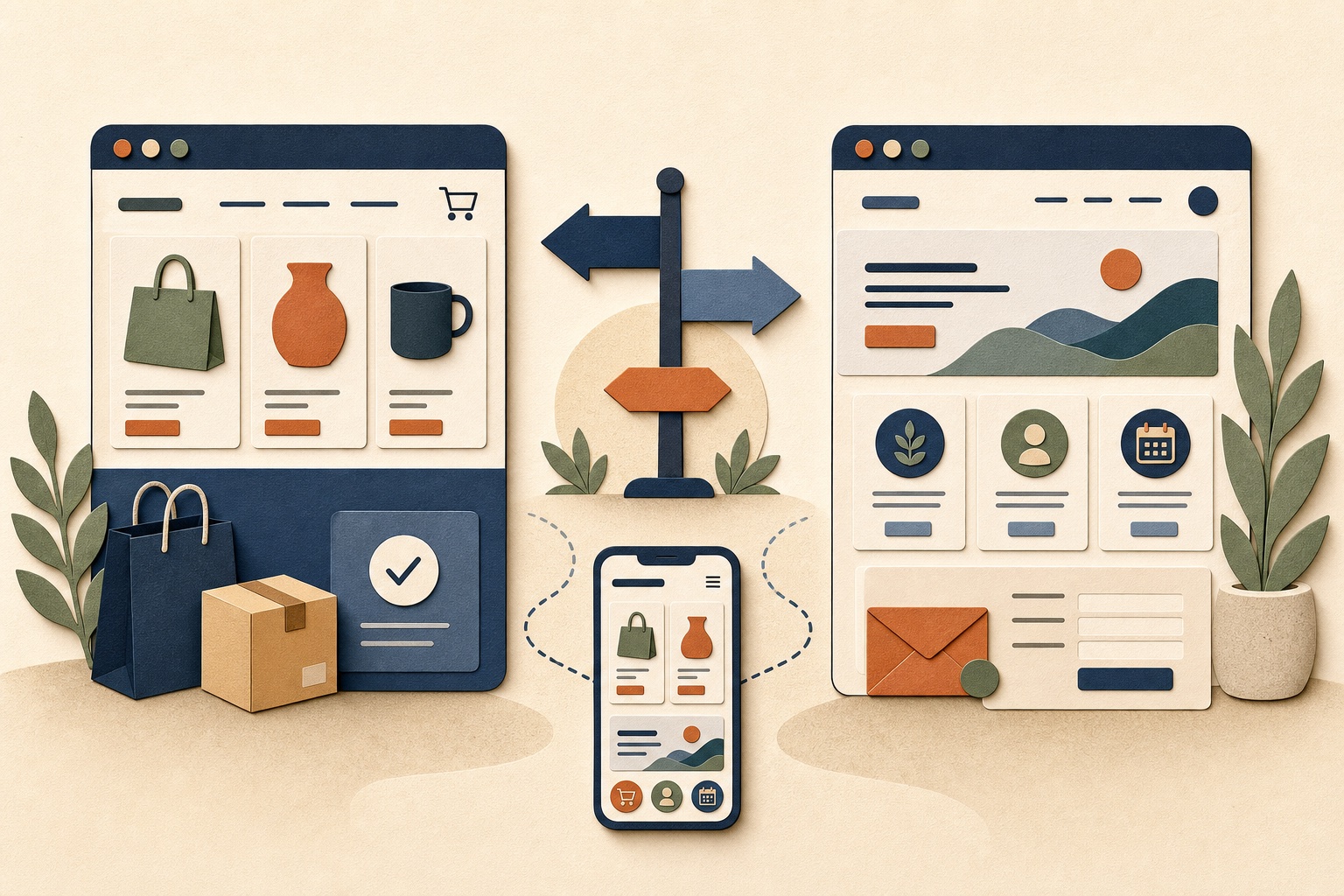
Choose Shopify when customers need to browse products, add items to a cart, pay online, and receive order communication. Choose a content-first business website when the main goal is explaining services, earning trust, generating leads, accepting inquiries, or supporting appointments. Use a hybrid when both journeys matter.
The short answer: start with the primary customer action
A website platform should support the action that creates value for the business. For a product company, that action may be completing an online purchase. For a contractor, consultant, agency, clinic, or other service provider, it may be calling, requesting an estimate, submitting an application, booking, or reading enough information to become a qualified lead.
Shopify is a complete commerce platform designed around products, inventory, cart, checkout, orders, payments, shipping, discounts, and customer communication; its current capabilities are summarized in Shopify's official platform overview. A standard business website is normally designed around pages, content, services, credibility, lead generation, and flexible presentation. Both can overlap.
Do not choose Shopify merely because it can publish pages, and do not choose a standard website merely because it can add a payment button. Choose the system that best supports the complete customer and operating journey.
Begin with these questions:
- What is the primary action a visitor should complete?
- Are customers buying defined products at published prices?
- Does the business need cart, checkout, inventory, shipping, tax, or order management?
- Does the sale usually require a conversation, estimate, application, appointment, or custom scope?
- How important are educational content, service pages, local search, and lead qualification?
- Who will operate and maintain the system after launch?
What does “regular website” mean in this comparison?
Every Shopify store is also a website. Here, “regular website” means a content-first small-business website built on a website builder, content-management system, or custom platform where ecommerce is not the central operating system.
That website might contain a homepage, service pages, location information, case studies, resources, FAQs, contact forms, appointment links, customer portals, or other features. It can also accept payments or connect to an online store, but its primary structure is not necessarily organized around a product catalog and checkout.
Shopify is not only a page builder
Its value is the connected commerce system behind the visible theme: products, variants, inventory, discounts, checkout, orders, payments, shipping, customer records, notifications, reports, applications, and administrative workflows. A business that does not need that system may be paying for complexity it does not use.
A content-first website is not automatically simpler
A service site can require deep strategy, original content, custom forms, booking, CRM integration, local-search structure, gated resources, accessibility work, or software features. “No cart” does not mean “no complexity.”
Shopify versus a content-first business website
| Decision area | Shopify | Content-first business website |
|---|---|---|
| Primary strength | Integrated online selling and order operations | Flexible content, services, lead generation, and presentation |
| Best-known customer action | Browse, add to cart, and purchase | Learn, trust, contact, request, call, book, or apply |
| Products and inventory | Core platform capability | Requires platform ecommerce features, plugins, embeds, or a connected store |
| Checkout and orders | Managed system designed for commerce | Depends on the selected ecommerce or payment solution |
| Service content | Supported, but within an ecommerce-centered platform | Usually a natural fit for flexible page and content structures |
| Lead generation | Forms and integrations are possible | Can be designed directly around inquiries, estimates, appointments, and qualification |
| Operating burden | Products, orders, fulfillment, returns, apps, and store settings | Content, forms, platform updates, integrations, and lead follow-up |
| Recurring costs | Plan plus domain, payment costs, and optional themes or apps | Domain plus hosting or platform plan and optional plugins, software, or maintenance |
| Customization | Theme, platform, app, checkout, and plan constraints apply | Varies widely by builder, CMS, custom stack, and hosting |
| Maintenance model | Core commerce hosting is managed; store, theme, apps, content, and operations still need ownership | Can be highly managed or self-managed depending on the platform |
This comparison describes typical strengths, not absolute limits. Shopify can support rich service content, and a content-first site can run substantial ecommerce. The question is how much configuration, integration, maintenance, and compromise the less-natural use case creates.
Choose Shopify when ecommerce is central
Shopify is normally the clearer choice when the business needs a complete store rather than a website with an occasional payment option.
Strong Shopify signals
- Customers browse a catalog with products, collections, or variants
- The business needs a cart and online checkout
- Inventory or product availability must be tracked
- Orders move through fulfillment, shipping, pickup, delivery, or digital delivery
- Discounts, gift cards, customer accounts, returns, or order notifications matter
- Payment, tax, and commerce reporting need to connect to the order system
- Retail or point-of-sale workflows may connect with online selling
- The team wants a managed commerce platform rather than assembling several separate systems
A product business also needs normal website content: brand story, policies, FAQs, contact details, educational guides, product support, and trust signals. Choosing Shopify does not remove the need to explain the business or earn customer confidence.
Shopify can also sell services and digital offers
A defined service, class, event, download, membership, or subscription may fit Shopify when customers can understand the offer, select an option, and pay through a standardized checkout. Feasibility depends on the exact model, required applications, policies, delivery method, and platform rules.
If every sale requires custom diagnosis, negotiation, a variable estimate, regulated intake, or substantial qualification, a forced shopping-cart experience may create more confusion than convenience.
Choose a content-first website when the sale begins with trust and conversation
A standard business website is usually the more natural foundation when visitors must understand expertise, compare services, review examples, confirm service areas, evaluate fit, or explain their situation before the business can recommend a solution.
Strong content-first website signals
- The business sells custom, quoted, or relationship-based services
- The primary conversion is a call, form, estimate request, consultation, appointment, or application
- Service pages, locations, case studies, resources, and FAQs drive discovery and trust
- The sales process continues in CRM, email, scheduling, or proposal tools
- There is little or no standardized online inventory
- Publishing flexible educational or local content is a major priority
- The site needs custom tools or workflows unrelated to ecommerce
- The business wants to minimize store settings and commerce administration it will not use
A content-first website can still accept a deposit, sell a small number of items, embed a booking system, connect payment links, or send customers to a separate checkout. Those additions should be evaluated against the customer experience, reporting, security, maintenance, and total operating workflow.
Our website design and development service is built around that broader customer journey rather than a predetermined platform.
Some businesses need a hybrid website
The choice does not have to be purely store or purely content. A business may educate visitors through service pages and resources while also selling products, bookings, downloads, classes, packages, or standardized services.
One Shopify site with strong content
This is often the simplest hybrid when ecommerce is still central. Build the store on Shopify, then create the service, educational, comparison, FAQ, and brand content required to support discovery and purchasing.
A content-first site connected to commerce
This can fit when services, publishing, or custom functionality dominate and the product catalog is secondary. Commerce might be handled through a subdomain, embedded product components, payment links, platform plugin, or connected store. The experience should feel intentional rather than sending customers through disconnected branding and navigation.
Separate experiences under one brand
Complex organizations may operate a main website and a separate store. This creates more control but also more responsibility: navigation, analytics, customer identity, content duplication, search indexing, domains, accessibility, and maintenance must work across both systems.
| Hybrid pattern | Best aligned with | Main caution |
|---|---|---|
| Shopify plus deeper content | Commerce-first businesses that also need education and lead generation | Plan information architecture carefully so content does not feel secondary or buried |
| Business site plus light payments | Service businesses collecting deposits or selling a few simple offers | Confirm how payments, receipts, refunds, tax, and customer records are managed |
| Business site plus connected store | Content or service brands with a meaningful but separate product operation | Avoid fragmented navigation, tracking, branding, and account ownership |
Compare total cost—not only the monthly platform price
Both approaches have starting and ongoing expenses. The responsible comparison includes the build, third-party tools, transaction costs, content, integrations, maintenance, and the internal labor required to operate the system. Use Shopify's live pricing and plan comparison when calculating platform costs because included features and rates can change.
| Cost area | Shopify considerations | Content-first website considerations |
|---|---|---|
| Platform | Recurring Shopify plan | Hosting, managed builder, CMS, or custom infrastructure |
| Domain and email | Normally separate from the store plan | Normally separate or bundled depending on the provider |
| Design and build | Theme setup, customization, product structure, store settings, and testing | Strategy, content, design, development, forms, integrations, and testing |
| Extensions | Optional paid theme and recurring or usage-based apps | Optional templates, plugins, integrations, licenses, or custom development |
| Transactions | Payment processing and possible plan- or provider-dependent transaction costs | Payment-provider and ecommerce-system costs when payments are added |
| Operations | Products, inventory, fulfillment, shipping, returns, support, and store administration | Content, lead handling, updates, technical maintenance, and connected business systems |
For current Shopify-specific categories, read How Much Does It Actually Cost to Start a Shopify Store? For broader website planning ranges, read What Does a Small-Business Website Cost in 2026?
A cheaper platform can become the more expensive choice when the business must force its workflow into an unsuitable structure, add several extensions, rebuild content, or maintain disconnected systems.
Neither platform automatically wins at SEO
Search engines do not reward a business simply for choosing Shopify, WordPress, a website builder, or custom code. Visibility depends on whether pages are accessible, useful, clearly organized, technically sound, relevant to real searches, supported by trustworthy business signals, and maintained over time. Google's ecommerce search guidance focuses on content, product data, site structure, crawlability, and launch practices rather than endorsing one platform.
Shopify search strengths and considerations
Shopify supplies a managed technical foundation, product and collection structures, editable page metadata, sitemaps, and other search necessities documented in its official SEO overview. The business still needs useful product information, collection strategy, internal links, unique content, image quality, structured information, redirects during changes, and control over unnecessary duplication from themes or apps.
Content-first website strengths and considerations
A content-centered platform can provide more natural structures for services, locations, case studies, comparisons, and extensive educational publishing. Its technical quality varies widely. Poor hosting, plugin conflicts, weak templates, missing maintenance, or careless custom code can outweigh theoretical flexibility.
The better SEO platform is the one the business can use to publish the right information, maintain technical quality, and support the customer journey consistently.
Our SEO and local search service considers the site, business information, content, measurement, and ongoing work together.
Understand ownership, portability, and maintenance
No website is maintenance-free. Managed platforms handle more infrastructure, but the business still owns decisions about content, access, billing, integrations, customer data, workflows, testing, and changes.
Shopify ownership model
The business should control the Shopify account, domain, payment setup, application billing, theme licensing, and recovery access after handoff. Shopify operates the hosted platform, while the merchant remains responsible for the store's products, claims, policies, customers, orders, applications, permissions, and operations.
Content-first website ownership model
Ownership depends on the system. The business may control a managed-builder account, hosting account, CMS, codebase, database, domain, or a combination. A proposal should state what can be exported, transferred, edited, backed up, and maintained without the original provider.
Document for either option:
- Domain registrar, renewal, DNS, and recovery access
- Platform or hosting owner and billing contact
- Administrative users and two-factor authentication
- Theme, plugin, application, and integration ownership
- Analytics, Search Console, payment, email, CRM, and advertising access
- Content, product, customer, and order export options
- Backup, update, testing, and emergency responsibilities
- What happens when the provider or platform changes
Use our monthly digital maintenance checklist to assign ongoing operational responsibility.
Common small-business scenarios
| Business situation | Likely starting point | Why |
|---|---|---|
| Local contractor requesting project details | Content-first website | Service explanation, local relevance, proof, estimates, and lead follow-up matter more than cart checkout |
| Product brand shipping a catalog nationwide | Shopify | Products, variants, payments, orders, shipping, and customer notifications are central |
| Consultant selling custom engagements | Content-first website | Expertise, qualification, case studies, and consultation requests lead to a scoped sale |
| Artist selling products and taking commissions | Hybrid, often Shopify-led | Products can use checkout while commissions follow an inquiry workflow |
| Retail shop adding online ordering | Shopify or another commerce-first system | Inventory, pickup, shipping, payments, and order operations require coordination |
| Fitness professional selling appointments and downloads | Hybrid | Service content and booking may lead, while standardized digital products use checkout |
| Restaurant, clinic, or regulated provider | Requirements discovery first | Industry rules, booking, ordering, privacy, locations, and integrations can determine the platform |
These are starting patterns, not automatic prescriptions. Existing systems, staff capacity, transaction volume, data, regulations, integrations, and future plans can change the recommendation.
Shopify or regular website decision checklist
Shopify is probably the stronger foundation if:
- Online product sales are central to the business model.
- Customers expect a catalog, cart, checkout, and order status.
- Inventory, fulfillment, shipping, discounts, and returns must work together.
- The business will actively manage products and store operations.
- A managed commerce platform reduces more complexity than it creates.
A content-first website is probably stronger if:
- The sale begins with explanation, trust, contact, qualification, or an estimate.
- Services, locations, case studies, resources, or appointments are the main content.
- Published prices and a standard checkout do not fit most engagements.
- The business needs flexible non-commerce workflows or custom features.
- Store administration would add little value.
Consider a hybrid if:
- Products and services are both meaningful revenue paths.
- The business needs extensive content and a real online store.
- Some offers can be purchased directly while others require consultation.
- The team can maintain the connections, analytics, and customer experience across both paths.
Before committing, map one real customer from discovery through the final business outcome. Include marketing, content, inquiry or checkout, payment, fulfillment or delivery, communication, support, reporting, and future updates. The platform should make that full journey easier to operate.
Frequently asked questions
Shopify versus regular website FAQ
Can Shopify be used as a regular business website?
Yes. Shopify can publish business pages, articles, forms, and service information. The decision is whether an ecommerce-centered platform and subscription are useful for the business's primary customer and operating needs.
Can a regular website sell products?
Yes. It can use built-in ecommerce, a plugin, embedded checkout, payment links, or a connected store. Confirm how product data, payment, tax, shipping, customer records, refunds, security, and maintenance work together.
Is Shopify better for SEO?
Not automatically. Shopify and other platforms can support strong search foundations. Useful content, relevant structure, technical accessibility, authority, competition, and ongoing execution matter more than the platform name alone.
Is Shopify only for physical products?
No. Depending on configuration and applicable rules, it can support eligible digital products, standardized services, subscriptions, events, and other offers. Confirm the exact requirements and platform support before building.
Can I start with a regular site and move to Shopify later?
Yes. Plan migration carefully across content, products, customers, domains, URLs, redirects, analytics, email, and integrations. Business-controlled accounts and organized source data make future changes safer.
What if the business already has a website?
Do not rebuild solely to change platforms. First identify the current site's actual limitations, customer problems, operating cost, search risk, and future requirements. Improving the existing system may be more responsible than replacing it.
Choose the customer path before the platform
Tell us what customers need to learn, do, book, or buy.
Overtime Innovations can review the offer, content, ecommerce requirements, lead process, integrations, and ongoing responsibilities before recommending a useful foundation.