
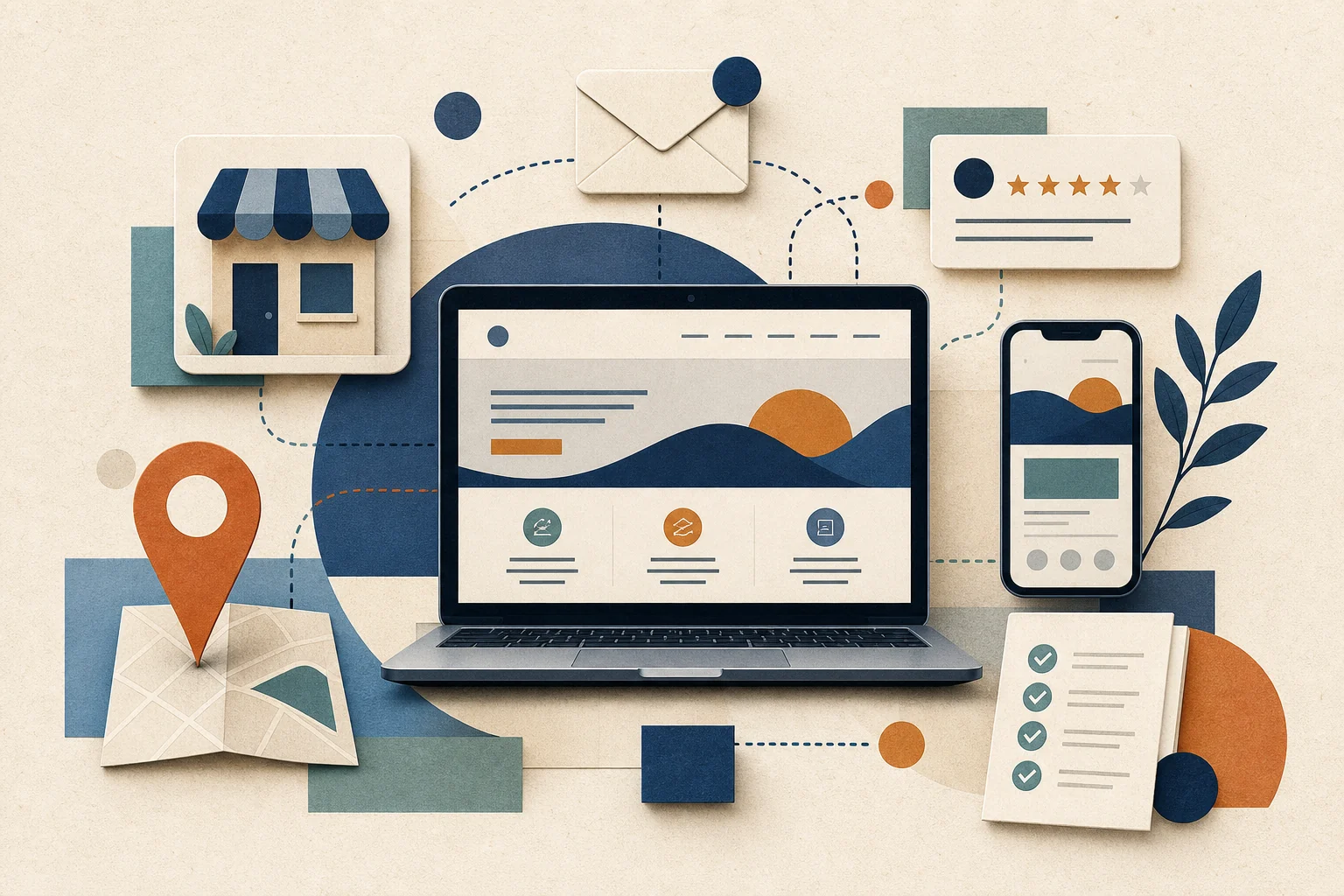
“Online presence” can sound like an endless list of accounts, tools, and marketing tasks. For most small businesses, the better approach is to build a few connected pieces in the right order.
1. Start with the customer and the business goal
Before choosing a website platform or social network, define who the business needs to reach and what you want that person to do. A local service company may need qualified calls and estimate requests. A retail business may need store visits or online orders. A professional practice may need consultation inquiries.
Write down one primary customer, one main problem you solve, and one next action. These three answers should guide the rest of the online presence.
Foundation questions
- Who is the most important customer right now?
- What problem or desire brings that person to the business?
- What makes the business a credible choice?
- What should the customer do next?
2. Make the message understandable
A visitor should not need to decode clever language to understand the business. State what you provide, who it is for, where you operate, and what makes the experience valuable.
Consistency matters. The business name, description, contact details, visual identity, and core offer should match across the website, search listings, social profiles, and email.
Clarity is usually more valuable than trying to sound larger, more technical, or more sophisticated than the business needs to be.
3. Treat the website as the online home base
Social profiles and business listings are useful, but they are controlled by other platforms. A website gives the business a stable place to explain its services, establish trust, answer questions, and capture inquiries.
Essential website elements
- A homepage with a clear offer and next action
- Dedicated pages for important services or product categories
- An About page that explains the people and approach behind the business
- Visible contact information and a useful inquiry path
- Privacy information and any policies customers need
- Responsive layouts, readable text, working links, and reasonable load times; Google strongly recommends a mobile-friendly site in its mobile-first indexing guidance
Start with the pages customers need to make a decision. Additional pages should exist because they answer a meaningful question—not simply to make the website appear larger.
4. Establish the local-search foundation
Businesses serving a geographic area should keep their name, address or service area, phone number, hours, categories, and website consistent wherever customers may find them. Google's current Business Profile representation guidelines explain how eligible businesses should present names, locations, service areas, hours, and categories. Complete the primary business listing and make sure the website clearly explains the locations served.
Search visibility is not created by repeating city names everywhere. Useful service information, accurate listings, customer-relevant pages, and a technically accessible website provide a stronger foundation.
5. Give customers reasons to trust the business
Customers look for evidence that the business is real, capable, and safe to contact. Use authentic information rather than unsupported claims.
- Real photos of the business, work, products, or team
- Clear contact details and service area
- Licenses, certifications, or professional memberships when relevant
- Honest reviews and testimonials when available
- Examples of work, products, or process
- Clear policies, expectations, and response times
If the business is new, do not invent proof. Explain the approach, show work you can honestly claim, and make the process transparent.
6. Create one reliable path from interest to follow-up
Every page should make the appropriate next step easy to find. That may be calling, completing an inquiry form, visiting a location, requesting an estimate, joining an email list, or purchasing. W3C's accessible forms tutorial recommends clear labels, instructions, validation, and feedback while asking only for information required to complete the process.
Test what happens after the action. Confirm where form submissions go, who is responsible for responding, what information is recorded, and how quickly the customer should hear back. A lead form without a follow-up process is not a complete system.
7. Choose content channels the business can maintain
You do not need every social platform. Choose channels based on where customers pay attention and what the team can realistically produce. A useful monthly article and email may outperform daily posts that have no clear purpose.
Build content around customer questions, misconceptions, decisions, product uses, completed work, and the expertise already present inside the business. Reuse strong ideas across formats.
8. Measure business movement, not just activity
Page views and follower counts can provide context, but they are rarely the complete goal. Google's Search Console Performance guidance explains how to evaluate search queries, pages, clicks, impressions, and click-through trends. Track those visibility signals as one part of a short chain from attention to business outcome.
Useful measures might include qualified inquiries, booking rate, online sales, repeat purchases, email signups, lead-response time, and the sources producing suitable customers.
A practical 30-day starting plan
- Week 1: Define. Clarify the priority customer, offer, differentiator, and desired action.
- Week 2: Fix the foundation. Correct contact information, listings, website messaging, mobile issues, and broken customer paths.
- Week 3: Add evidence. Improve service descriptions, authentic visuals, policies, work examples, and trust information.
- Week 4: Connect and measure. Test inquiries, organize follow-up, select a manageable content cadence, and establish a simple scorecard.
After these pieces work together, expand based on evidence. The right next investment may be SEO, content, email, ecommerce, automation, or a larger website—not necessarily all of them at once.
The main takeaway
Build a connected system, not a collection of accounts.
A strong online presence helps customers move from discovery to understanding, trust, action, and follow-up. Start with the weakest part of that journey and improve it before adding more channels.
Tell Us About Your Business