
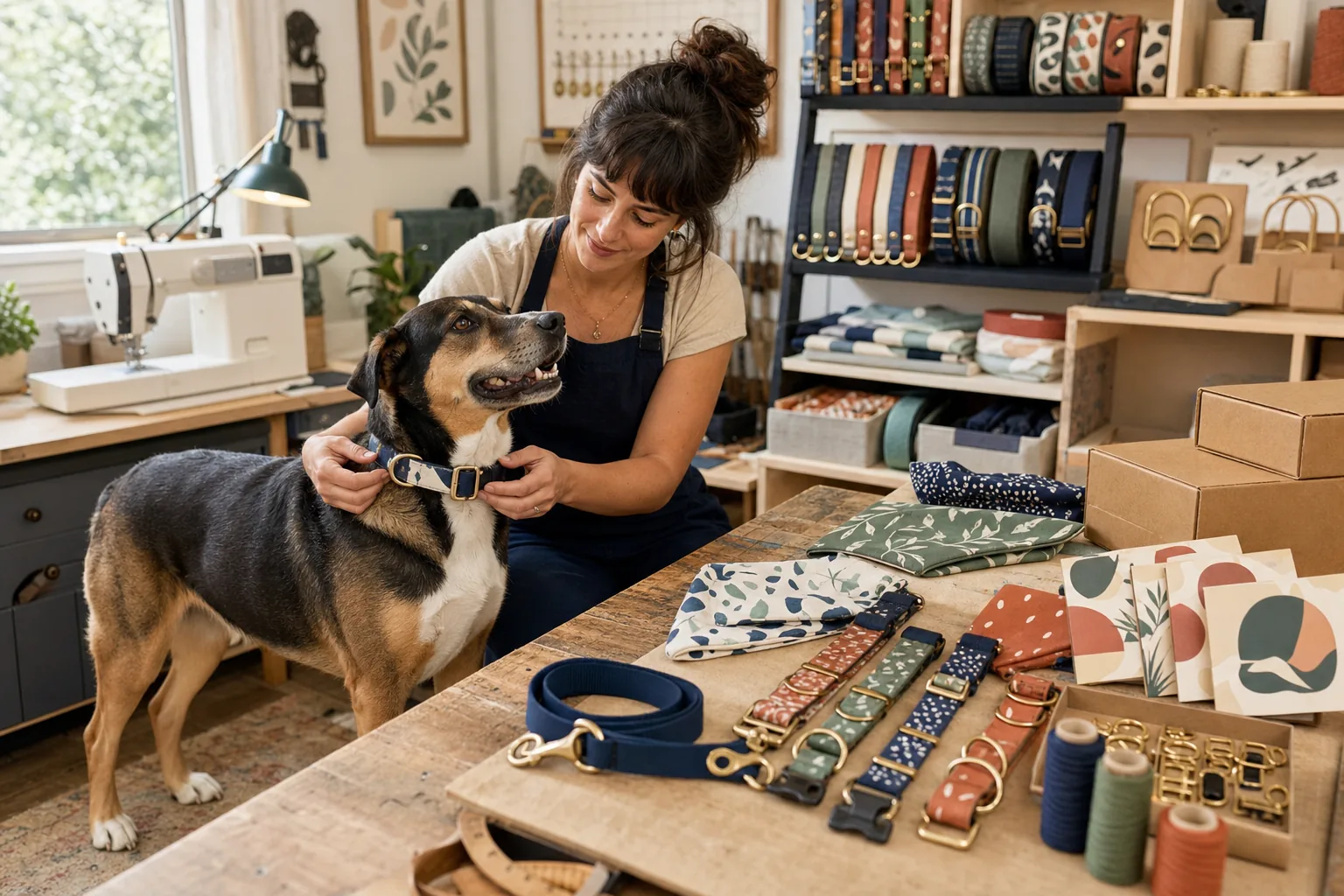
To launch a handmade pet-accessory store successfully, limit the first catalog to products with a defined intended use, build a measurement-based sizing system, document every material and hardware component, test the complete construction under relevant conditions, publish honest performance limits, show accurate fit and scale, control personalization, price quality and replacement risk, and give owners clear inspection, care, and retirement guidance.
The short answer: help the owner choose for the actual animal
A pet owner cannot confirm fit, feel the fabric, inspect a buckle, test a closure, or compare two sizes through a screen. The product page must provide the information that replaces those checks without pretending that a photo, breed label, or weight estimate guarantees fit.
Separate products that carry load or affect containment from products that are decorative. A collar used for walking, a decorative bandana that slides over a collar, a breakaway cat collar, a crate mat, and a bow tie have different failure consequences and need different evidence, warnings, and customer instructions.
Cute earns the click. Fit, construction, and honest intended use earn the order.
1. Choose a product scope the business can test and explain
| Category | Core buying question | Operational focus |
|---|---|---|
| Collars and harness accessories | Will it fit, adjust, close, and perform for the stated use? | Measurement range, hardware, load path, inspection, warnings |
| Leashes and traffic handles | What animals and activities is the construction intended for? | Length, width, connection hardware, seams, grip, testing |
| Bandanas, bows, and neckwear | How does it attach and what size collar or neck does it fit? | Attachment method, decorative-use boundary, supervision, care |
| Pet apparel | How do neck, chest, back, and leg openings fit? | Multiple measurements, movement, closures, fabric, laundering |
| Tags and charms | What is readable, durable, and compatible with the attachment? | Dimensions, weight, text limits, edges, hardware, wear |
| Beds, blankets, and mats | What are the finished dimensions, support, cover, and cleaning method? | Fill, seams, closures, washability, chewing and supervision limits |
| Travel and organization accessories | What does it hold, attach to, or protect? | Compatibility, load, closure, cleaning, vehicle-use boundary |
Keep treats, supplements, grooming chemicals, flea or tick claims, medical devices, and products intended to diagnose or treat conditions out of a general accessory catalog unless the business understands the separate regulatory, testing, insurance, and professional requirements.
2. Define intended use before selecting materials
Write one precise intended-use statement for each product. “Pet accessory” is not enough. Is the item decorative neckwear, an identification collar, a walking collar, a leash for ordinary supervised walks, a garment for brief outdoor wear, or a washable indoor mat?
State important exclusions
- Not for tie-out, unsupervised restraint, climbing, lifting, vehicle restraint, or use as safety equipment unless specifically designed and supported for that use
- Not chew proof, indestructible, escape proof, or suitable for every animal
- Not a substitute for a properly fitted harness, identification system, professional training, or veterinary care
- Remove decorative items during crating, rough play, sleep, swimming, or unsupervised use when that is the safe product instruction
- Discontinue use after damage, deformation, loose stitching, worn hardware, poor fit, irritation, or changed animal size
Warnings should follow the product wherever the owner decides: listing, packaging, care card, and support material. They should be specific enough to act on, not buried behind “use responsibly.”
3. Build sizing from measurements—not breed names
Breed, age, and weight can help with context, but animals of the same breed or weight can have different necks, chests, backs, coats, and proportions. Use product-specific body measurements and publish the finished product's actual range.
A useful sizing system includes:
- An illustration or photograph showing exactly where the measuring tape sits
- Instructions to measure the pet while standing naturally, using a flexible tape
- The required fit allowance and whether it is added by the customer or already included
- Finished minimum and maximum adjustable range for each size
- Width, thickness, weight, opening, and coverage where relevant
- Guidance for pets between sizes, growing animals, heavy coats, or unusual proportions
- A final fit check after delivery and instructions not to use an item that cannot be fitted correctly
Do not publish a collar's cut webbing length as its usable range. Buckles, folds, sliders, keepers, overlap, and hardware change the finished dimensions. Measure completed inspected products using a documented method.
For apparel, neck circumference alone is rarely enough. Chest girth, back length, leg openings, body shape, closure overlap, stretch, and movement may matter. Show which measurement determines the size when several do not land in the same row.
4. Document every load-bearing, contact, and decorative component
Save the supplier, part number, lot, dimensions, material, finish, and relevant technical information for webbing, leather, fabric, interfacing, thread, rivets, buckles, snaps, D-rings, sliders, clasps, elastic, hook-and-loop, labels, coatings, dyes, adhesives, fill, foam, and packaging.
Ask component-level questions
- Is the material used in the structural load path or only as a decorative cover?
- Can moisture, dirt, laundering, salt, UV exposure, or abrasion change it?
- Can plating wear, hardware corrode, an edge become sharp, or a coating transfer?
- Does a closure behave differently with fur, tension, grit, or cold fingers?
- Could a charm, bead, bell, zipper pull, or loose part become a chewing or ingestion hazard?
- Does one pattern direction, fabric repeat, hide, or handmade cut create meaningful visual variation?
“Premium hardware,” “marine grade,” “genuine leather,” and “organic fabric” are claims that should be specific and supported. If a foreign buckle and imported webbing are assembled domestically, do not turn “handmade in our U.S. studio” into an unqualified “Made in USA” claim. The FTC's Made in USA guidance explains the “all or virtually all” standard and qualified claims.
5. Test the complete construction, not only the individual components
A supplier rating for webbing or a metal ring does not automatically establish the strength, breakaway behavior, durability, or safe use of a finished item. Seams, folds, hole placement, rivets, thread, edge finishing, hardware orientation, adjustment, wear, moisture, and manufacturing variation affect the system.
Create a risk-based test plan
- Dimensions: Verify finished adjustable range, width, length, opening, and tolerance across production
- Static and cyclic loading: Use a qualified method appropriate to the stated use and foreseeable motion
- Closure and adjustment: Check buckles, snaps, slides, clasps, hook-and-loop, and breakaway mechanisms across the range
- Wear: Evaluate abrasion, flexing, edge wear, seam movement, corrosion, water, dirt, UV, and cleaning where relevant
- Small parts and edges: Inspect for loose components, sharp points, burrs, fragments, and accessible attachment failures
- Fit and movement: Use supervised evaluations with appropriate animals and professional input when necessary
- Packaging and storage: Confirm products arrive dry, clean, undeformed, and complete
Define acceptance criteria before the test. Keep records of the exact product version and seek qualified product-safety, engineering, veterinary, or legal guidance for safety-related designs. Do not conduct improvised destructive testing on an animal.
6. Give every product a complete physical specification
Each listing should address:
- Product type, intended use, and important prohibited uses
- Finished dimensions, adjustment range, width, weight, and measurement tolerance
- Materials and which components touch the animal
- Hardware type, finish, placement, and included attachments
- Construction method, layers, seams, closure, and decorative elements
- Sizing instructions, fit allowance, between-size guidance, and final fit check
- Pattern placement, leather, wood, color, or handmade variation
- Personalization location, character limits, readability, and proof policy
- Supported durability, water, breakaway, reflective, visibility, hypoallergenic, or other claims
- Supervision, inspection, care, retirement, and replacement guidance
- Made-to-order timing, packaging, shipping, returns, and fit-remedy policy
Use plain language. If a bandana is designed to slide over an existing collar, state the maximum collar width and the opening dimensions. If a bow attaches with elastic loops, show the loop. If a tag is decorative rather than a primary identification device, say so.
7. Photograph construction, attachment, fit, and scale
Shopify's product-media guidance supports images and video that help buyers understand product size and quality. Pet-accessory galleries should show the physical details an owner needs to assess.
| View | Question it should answer |
|---|---|
| Complete product | What exactly arrives? |
| Front and reverse | How are layers, seams, labels, and attachments finished? |
| Hardware close-up | What buckle, ring, clasp, slider, snap, or closure is used? |
| Measurement view | Where are length, range, width, opening, or coverage measured? |
| On-animal fit | How should it sit on a suitable supervised animal? |
| Motion view | Does the garment or accessory allow intended movement? |
| Package contents | Which components, care materials, and accessories are included? |
Do not hide attachment methods, use an obviously wrong size for the photograph, or depict a decorative item performing a safety function. On-animal images should show calm, supervised use without distress, dangerous environments, or misleading restraint.
8. Use variants for valid size, color, and hardware combinations
Shopify's current variant guidance supports choices such as size and color, with separate inventory for each combination. Keep the matrix small enough that every combination has the right price, materials, measurements, photo, production method, and inventory.
A narrow cat breakaway collar and a heavy walking collar should be separate products, not two sizes of one item. A harness-style garment may need a different pattern and fit explanation for each body shape. When the product, construction, intended use, or sizing logic changes, a separate listing is often clearer.
Useful variant rules
- Size names always map to a published measurement range.
- Width is separate from neck range when both change fit or suitability.
- Hardware upgrades are offered only when compatible and properly tested.
- Pattern and material availability match real stock.
- Variant photos show meaningful color, fabric, hardware, and construction differences.
9. Control names, phone numbers, tags, and custom artwork
Personalization can increase the value of a collar, tag, bandana, blanket, or garment, but errors can affect identification as well as appearance. Define exactly what will be reproduced and how it will fit.
- Set character and line limits based on tested readable results.
- Show capitalization, punctuation, abbreviation, and font examples.
- Explain whether text size changes for longer names or numbers.
- Require customers to review contact information before checkout and proof approval.
- Define engraving, embroidery, print, patch, label, or tag placement.
- Use a proof when artwork, layout, crop, spelling, or roster data needs approval.
- Confirm permission before reproducing customer logos, photographs, or third-party artwork.
The U.S. Copyright Office explains that the owner of original visual artwork controls making and selling copies. Customer-upload terms help document permission, but they do not make unauthorized characters, sports marks, brand logos, or copied designs safe to reproduce.
10. Support safety, durability, material, and origin claims
The FTC's advertising guidance for small businesses says advertising must be truthful and evidence must support objective claims. For pet accessories, that includes express or implied statements about strength, durability, waterproofing, reflectivity, visibility, breakaway release, escape resistance, chew resistance, odor, bacteria, allergens, calming, anxiety, temperature, joint support, or safety.
High-risk words need high-quality support
- Indestructible or chew proof: Broad absolute claims are difficult to support across animals and use conditions.
- Escape proof: Fit, anatomy, movement, handling, and adjustment can change containment.
- Breakaway: Release behavior should be defined and evaluated across sizes, directions, wear, and conditions.
- Reflective or high visibility: State what material is reflective and avoid implying that it makes nighttime activity safe by itself.
- Hypoallergenic or non-toxic: These may communicate health or safety claims requiring appropriate evidence.
- Calming, anti-anxiety, orthopedic, or therapeutic: Avoid health or behavioral promises without qualified evidence and professional guidance.
Place qualifications next to the claim. A testimonial, money-back guarantee, or supplier marketing phrase is not a substitute for evidence about the finished product.
11. Make inspection and retirement part of the product
Care instructions should preserve both cleanliness and function. State whether the product is hand wash, machine wash, wipe clean, spot clean, air dry, or unsuitable for soaking. Identify detergents, heat, bleach, dryers, oils, leather treatments, and hardware care where relevant.
Tell owners what to inspect
- Loose, skipped, cut, or abraded stitching
- Frayed webbing, stretched elastic, cracked leather, torn fabric, or exposed fill
- Bent rings, worn plating, corrosion, sharp edges, loose rivets, or deformed clasps
- Buckles or slides that no longer close, release, or hold adjustment correctly
- Chew damage, tooth marks, missing pieces, and detached decorations
- Fit changes caused by growth, coat, weight, grooming, or wear
Explain when to stop using and replace the item. Do not tell customers to repair safety-related construction unless the business has validated the exact repair and can provide appropriate instructions.
12. Price testing, skilled labor, and replacement risk
A sustainable price includes fabric or leather, webbing, interfacing, thread, hardware, tags, personalization, cutting, skiving, edge finishing, sewing, riveting, embroidery or engraving, pattern development, testing, failed pieces, labor, equipment, maintenance, photography, packaging, fees, support, replacements, insurance, overhead, risk, and profit.
| Product type | Cost often missed |
|---|---|
| Collar | Multiple hardware parts, reinforcement, adjustment, sizing inventory, and testing |
| Leash | Length of material, end construction, clasp selection, load testing, and packaging |
| Bandana or bow | Pattern matching, turning and pressing, multiple attachment sizes, and low order value |
| Apparel | Pattern grading, fit samples, several body measurements, and higher size-return risk |
| Personalized tag | Unique setup, legibility checks, contact-data responsibility, and small-part packaging |
| Bed or mat | Fill, dimensional shipping weight, washable construction, storage, and return freight |
Do not copy a marketplace price without understanding whether it covers compliant materials, accurate labor, testing, customer service, replacements, and profit. Bundles and minimum order thresholds can improve economics for low-priced accessories.
13. Separate component stock from sellable finished inventory
Fabric on a bolt and hardware in a bin do not guarantee that every online variant can be produced. Pattern repeat, defects, dye lots, leather variation, matching components, setup, labor, machine capacity, and current commitments affect availability.
- Raw components: Verified materials and hardware available for planned production
- Reserved components: Assigned to paid orders, wholesale work, replacements, or samples
- Work in progress: Cut or assembled but not fully inspected
- Finished inventory: Complete, approved products ready to sell
- Seconds or unsellable: Clearly separated from normal inventory and never used for safety-related products without appropriate disposition
For made-to-order products, set capacity around cutting, personalization, sewing or assembly, testing, inspection, packing, and support—not theoretical material supply. Shopify inventory can track each variant, but the business needs a process for component allocation and production limits.
14. Build sets around compatibility and real customer use
Matching collar-and-leash sets, bandana packs, walking kits, seasonal apparel, travel organizers, gift sets, and replacement accessories can raise order value. Confirm that every component is compatible and that the set does not imply an unsupported use.
Show exact contents, individual sizes, colors, materials, and savings. A “walking set” should not place a decorative collar into a load-bearing role. A gift set should still require accurate sizing before it is purchased or redeemed.
Shopify bundles may require a bundle solution, and subscriptions add recurring inventory, size changes, cancellations, and customer-service obligations. A manually defined fixed set is often enough for a first launch.
15. Package to protect shape, cleanliness, hardware, and presentation
Keep finished products clean and dry, prevent hardware from scratching other components, protect tags and decorations from bending, and avoid compressing beds or structured apparel beyond tested recovery. Include all attachments, care instructions, and sizing or fit checks.
Test the complete package
- Sealed weight and dimensions
- Movement, abrasion, moisture, crushing, and hardware contact
- Whether folds create permanent creases or deformation
- Whether small components can escape the inner package
- How the customer identifies sizes and matching pieces in a multi-pet order
- Return packaging for an unused fit exchange when offered
Publish processing separately from carrier transit. Do not guarantee an event, birthday, adoption, or holiday arrival unless the full production and delivery commitment can actually support it.
16. Create a fair process for fit, defects, damage, and personalization
Fit issues can come from incorrect customer measurement, unclear instructions, production outside tolerance, a changed animal, or a sizing model that needs improvement. Collect enough information to identify the cause without assuming blame.
Define separate remedies for:
- An unused standard product that does not fit
- A personalized product made correctly to the approved information
- A product produced outside the published measurement tolerance
- Wrong color, size, hardware, text, or item sent by the shop
- Construction defect, detached component, sharp edge, or early failure
- Transit damage, loss, or missing pieces
- An item that has been worn, washed, chewed, altered, or contaminated
Keep potentially unsafe returns out of resale inventory until they are evaluated. Track defects and incidents by product version, material lot, hardware, size, and production record, and obtain professional guidance if a pattern could indicate a broader safety problem.
17. Give retailers, groomers, rescues, and event buyers a quote path
Wholesale and collaboration orders can create repeat demand, but they introduce assortment, display packaging, barcodes, resale terms, private labels, exclusivity, deadlines, batch consistency, returns, and claims made by another seller.
A useful inquiry captures:
- Buyer, organization, sales channel, destination, and intended customer
- Products, sizes, colors, materials, hardware, quantities, and packaging
- Personalization, private-label, artwork, licensing, and approval requirements
- Requested delivery date, split shipments, and reorder expectations
- Wholesale price, minimums, deposit, payment, cancellations, and changes
- Which product descriptions, claims, warnings, and care information the retailer must preserve
Use a written specification and approved sample. A buyer's requested claim does not remove the maker's responsibility to support what is communicated about the product.
18. Build search visibility around product, pet, fit, and use
Useful collection paths can include adjustable dog collars, breakaway cat collars, over-the-collar bandanas, personalized pet tags, small-dog apparel, matching collar-and-leash sets, washable crate mats, and pet gift sets—only where the products truly meet those descriptions.
Product titles should combine a clear product name with material, size, attachment, or personalization information that helps the buyer. Descriptions should answer measurement, fit, materials, hardware, intended use, inspection, care, production, and shipping questions in natural language.
Content that can attract qualified owners
- How to measure a dog for the shop's exact collar system
- How collar width and hardware affect fit
- Over-the-collar versus tie-on bandanas
- How to inspect and retire a leash or collar
- How to clean the exact materials the maker uses
- How personalization, proofs, and multi-pet orders work
Partner with groomers, trainers, photographers, rescues, pet-friendly retailers, and local events when the relationship is real and claims remain accurate. Ask permission before publishing customer pet photos, names, stories, or identifying information.
19. Launch a focused collection that can be measured and tested
Before opening checkout:
- Select up to ten products with a precise intended use
- Document finished dimensions, sizing method, materials, hardware, construction, and tolerance
- Complete risk-based testing and preserve relevant evidence
- Write clear claims, warnings, supervision, inspection, care, and retirement guidance
- Photograph the exact products, construction, attachment, scale, fit, and package
- Calculate sustainable prices including testing, support, replacements, and insurance
- Set personalization rules, proofs, processing time, and production capacity
- Test packaging and shipping for every major product form
- Write fit, custom-product, defect, damage, and return terms
- Test variants, inventory, checkout, notifications, taxes, shipping, and mobile display
A focused launch might contain one tested collar system, one leash, two decorative attachments, one tag, and coordinated sets. It is better to explain a small system completely than to list every pet product the maker could theoretically produce.
20. What the free Shopify build can cover
For accepted US small businesses, Overtime Innovations can build one new Shopify client-transfer store at no build fee. The standard scope includes up to ten products, up to three collections, and basic launch copy and graphics prepared from materials supplied by the business.
The typical build takes 10–15 business days once required materials are ready, generally includes up to three consolidated revision rounds, and comes with 14 days of email-only support beginning on Day 0. The business remains responsible for product design, testing, sizing, claims, warnings, insurance, legal compliance, customer service, and professional advice.
Outside the standard free scope
- Work inside an existing Shopify store
- Interactive measuring tools, fit calculators, or product recommendation engines
- Live personalization previews, customer uploads, or automated proofs
- Subscriptions, wholesale portals, complex bundles, or B2B systems
- Production, embroidery, shipping, accounting, or inventory integrations
- Custom applications, paid apps, premium themes, testing, certification, or compliance work
The owner pays Shopify plan charges, domain costs, payment processing, themes or apps they choose, materials, hardware, equipment, testing, packaging, shipping, taxes, insurance, professional guidance, and other third-party expenses.
Frequently asked questions
Is Shopify good for a handmade pet-accessory business?
It can provide a branded home for a maker with defined products, reliable sizing, and a plan to attract traffic. Shopify can manage standard variants and inventory, while complex fit or custom projects may need a separate inquiry workflow.
What belongs on a pet-accessory product page?
State intended use, materials, hardware, measurements, sizing, adjustment, weight, construction, personalization, supported claims, warnings, inspection, care, processing, packaging, shipping, and returns.
How should customers measure a pet?
Show the exact body location and method using a flexible tape, state the fit allowance, and map the result to the finished product's measured range. Breed and weight alone are not dependable sizing systems.
Can a decorative accessory be used for walking or restraint?
Only make that claim when the complete construction is designed, tested, and supported for the use. Label decorative items clearly and state relevant supervision and prohibited-use guidance.
How should handmade pet accessories be priced?
Include materials, hardware, personalization, cutting, construction, testing, failures, labor, equipment, packaging, fees, support, replacements, overhead, insurance, risk, and profit.
Can Overtime Innovations build the store for free?
The standard offer covers one new Shopify client-transfer store with up to ten products and three collections for an accepted US small business. Advanced measuring, previews, uploads, wholesale, integrations, and existing-store work are outside that scope.
Build trust into every measurement, seam, and claim
A pet-accessory brand grows when owners understand what fits, what the item is meant to do, how to use it, and when to stop using it. That confidence should be visible before checkout and supported by the process behind every order.
Ready to prepare the first collection?
- Select up to ten clearly defined pet accessories
- Document measurements, materials, hardware, construction, tests, and claims
- Prepare accurate fit photography, pricing, packaging, and policies
- Confirm the standard build fits without advanced measuring tools or integrations