
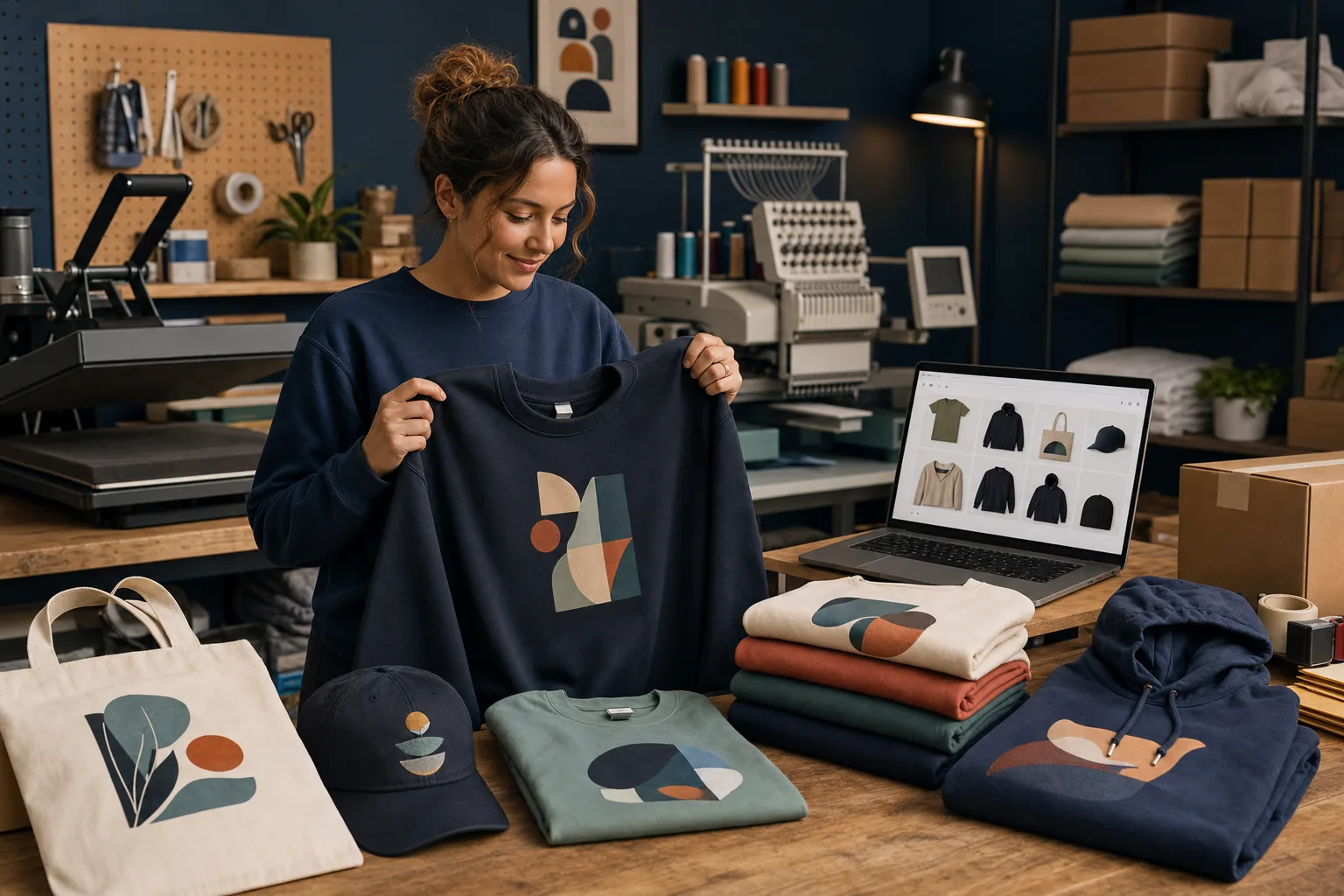
To sell custom apparel online successfully, separate standardized products from quoted projects, control the garments and decoration methods offered, make size and color choices easy to understand, review customer artwork before production, record approvals, price setup and spoilage, and connect every online order to a repeatable production and quality-control process.
The short answer: sell the job the shop can reproduce
A predesigned T-shirt offered in six sizes and four tested colors can move through normal checkout. A 150-piece company order with several garments, three decoration locations, individual employee names, uncertain artwork, and an event deadline should normally go through review, proofing, a quote, and an invoice.
The online store should expose that boundary. Let customers buy clear, repeatable products directly. Route brand logos, roster data, special placements, supplied garments, large quantities, and deadline-sensitive work through a controlled inquiry.
The checkout should reduce production questions—not deliver a pile of unanswered ones after payment.
1. Decide what kind of custom apparel business is going online
| Offer type | What the customer expects | Useful online workflow |
|---|---|---|
| Original apparel brand | Buy a finished design in available sizes and colors | Standard catalog, inventory, and checkout |
| Personalized products | Add a name, number, short phrase, or controlled choice | Product options with clear limits and preview or proof rules |
| Customer-logo apparel | Put supplied business, event, or organization artwork on approved garments | Artwork intake, review, proof, quote, and approval |
| Team, school, or group stores | Order from an approved design and product collection during a defined window | Dedicated collection or campaign with deadlines and fulfillment terms |
| Print-on-demand brand | Order finished products produced by a third party | Supplier integration, honest mockups, sample testing, and clear fulfillment terms |
| Contract decoration | Have a shop decorate supplied or sourced goods | Qualification form, written specifications, risk terms, quote, and invoice |
A shop can operate more than one model, but the customer path should change with the risk. A buyer choosing a standard hoodie should not complete the same form as a purchasing manager planning a multigarment employee program.
2. Build a catalog around proven garments and real buyers
A small launch catalog is easier to price, photograph, stock, explain, and produce. Begin with garments that have already been tested using the exact decoration process and supplier the shop plans to use.
Useful catalog paths
- By product: T-shirts, sweatshirts, hoodies, polos, jackets, hats, totes, uniforms, youth apparel, and workwear
- By buyer: Local businesses, creators, teams, schools, nonprofits, event organizers, clubs, and families
- By purpose: Staff uniforms, merchandise, fundraisers, reunions, races, weddings, launches, gifts, and employee recognition
- By method: Screen printing, embroidery, direct-to-film transfers, sublimation, heat-transfer vinyl, or another process the shop actually supports
Do not advertise every blank in a supplier catalog as if each one has been tested. Choose a dependable good-better-best range when customers need price levels. Record supplier style number, fabric content, weight, fit, available sizes, color range, restock behavior, and decoration compatibility.
For the first Shopify build, ten strong products with useful collections are more valuable than hundreds of thin listings copied from a wholesaler.
3. Make each product page answer the production questions
Every custom apparel product page should explain:
- Garment brand or source style, product type, fabric composition, weight, and construction
- Fit description and an accurate size chart for the specific garment
- Available garment colors, sizes, and relevant stock limitations
- Decoration method, design, print or thread colors, dimensions, and placement
- Whether the listing uses photographs, digital mockups, or both
- What can be personalized and what cannot
- Whether artwork review, digitizing, setup, or a proof is included
- Minimum quantity, quantity breaks, and whether colors or garments can be mixed
- Production time, approval cutoff, rush availability, and carrier transit
- Care instructions and expected aging for the garment and decoration
- Cancellation, return, exchange, remake, and defective-item policies
Photograph a real decorated sample when possible. A digital mockup can show the concept, but it should not exaggerate print size, embroidery detail, garment drape, texture, or color accuracy. Label mockups honestly and include close views of the actual decoration.
Size information is part of the product
Do not reuse a generic size chart across unrelated blanks. Show measurements, explain whether they describe the garment or body, state how they were taken, and include fit notes supported by the supplier or real testing. If decorated apparel is not freely exchangeable, customers need enough information to choose before production.
4. Control sizes, colors, designs, and personalization
Shopify variants are appropriate for real product combinations such as garment size and color. Shopify's current variant guidance explains that each combination can be managed as a variant, including inventory. Its variant setup documentation currently allows up to three options and 2,048 variants per product, while noting that some themes, applications, channels, and older integrations may have lower practical support.
That technical limit is not a reason to create every theoretical combination. Remove colors or sizes the supplier does not offer, that the shop has not tested, or that do not work with the design. Verify theme and application behavior before launching a large variant matrix.
Use the right type of option
- Use variants when size, color, garment style, or another selection creates a distinct sellable item with its own availability or price.
- Use suitable personalization fields for an order-specific name, number, short phrase, or instruction.
- Use separate products when garments need substantially different descriptions, photography, size charts, pricing, or fulfillment.
- Use an inquiry when the combination requires artwork review, uncertain pricing, unusual placement, or manual sourcing.
Carry every selection into the cart, order, proof, and production record. Test how long product names and option values display on mobile, in notification emails, on packing slips, and in internal workflows.
5. Put customer artwork through a real intake process
Artwork uploaded for apparel may be a screenshot, a compressed social-media image, a logo with missing fonts, a design with too many colors, or content the customer does not have permission to reproduce. The file is a request—not automatically a production-ready asset.
Define before accepting artwork
- Accepted vector and raster file formats
- Minimum resolution and physical dimensions
- Color mode, spot-color, transparency, and background expectations
- Minimum line, text, and negative-space sizes for each method
- Whether fonts must be outlined or supplied
- How photographs, gradients, distressing, and fine details are handled
- Fees for cleanup, vector conversion, separation, or embroidery digitizing
- What happens when artwork cannot produce an acceptable result
- Customer confirmation that they can authorize the requested reproduction
- File security, access, retention, and deletion practices
Customer uploads generally require a suitable Shopify application, custom form, or separate secure intake workflow. A standard product page does not automatically provide every file-review, storage, and approval function an apparel shop may need.
Do not reproduce logos, characters, team marks, music artwork, or other protected material simply because someone supplied a file. Establish written intellectual-property rules and obtain qualified legal advice when ownership or permission is uncertain.
6. Make proof approval a recorded production event
A useful proof identifies the garment, garment color, artwork version, decoration method, approximate dimensions, location, orientation, and relevant colors. For embroidery, it may also need a stitched sample. For color-critical or high-volume work, a physical sample or production test may be more appropriate than a screen proof.
Proof policy essentials
- When the first proof is delivered
- Which contact can approve it
- What the customer must inspect
- How approval must be recorded
- How many revisions are included
- What counts as a new design or paid change
- Whether garment or ink colors on screen are approximate
- When production time begins
- How delayed approval affects the promised date
- What happens if the customer stops responding
Save the approved proof and approval message with the order. For team rosters or personalized names and numbers, provide a structured review and lock the final data version before production. A corrected spreadsheet arriving after decoration begins is not a normal revision.
7. Calculate the complete cost of the apparel job
The blank garment is only one part of the price. Include:
- Garment cost, inbound freight, supplier fees, and replacement availability
- Artwork review, cleanup, separations, vector conversion, or digitizing
- Screens, transfers, film, ink, thread, stabilizer, vinyl, pretreatment, or other consumables
- Machine setup, hooping, platen changes, test prints, alignment, and color changes
- Decoration time, operator labor, curing, trimming, weeding, pressing, and finishing
- Spoilage, misprints, damaged blanks, reorders, and quality-control allowance
- Individual names, numbers, sleeve prints, extra locations, and roster handling
- Folding, bagging, tags, inserts, sorting, kitting, and shipping preparation
- Shopify, payment processing, applications, discounts, customer service, and returns
- Equipment, maintenance, utilities, rent, insurance, software, professional advice, overhead, risk, and profit
Build pricing that customers can understand
A standard product can use a clear base price with visible additions for extended sizes, personalization, extra locations, or premium garments. A quoted job can use defined quantity tiers, setup charges, artwork fees, and optional services.
Do not promise a low unit price based only on quantity. Ten colors, six garment styles, individual names, difficult artwork, separate bagging, and multiple shipping addresses can make a large order more labor-intensive than a simple run. Confirm whether different sizes and colors can be combined toward a price tier.
8. Decide whether blanks are stocked, ordered, or fulfilled elsewhere
| Inventory model | Advantage | Operational risk to explain |
|---|---|---|
| Stock core blanks | Fast access and direct availability control | Cash tied up in sizes, colors, and slow-moving products |
| Order after sale | Broader catalog with less owned inventory | Supplier stockouts, substitutions, split shipments, and variable lead times |
| Hybrid | Core speed plus broader special-order range | Customers need clear availability and timing differences |
| Print on demand | No in-house decoration or finished inventory | Supplier quality, packaging, margin, production time, and return limits |
Map each Shopify variant to the exact blank SKU and supplier information used in production. If supplier inventory is not synchronized reliably, do not imply live availability. Define substitution rules in advance; changing the garment brand, fabric, fit, or shade after purchase normally requires customer approval.
Order and test samples from any print-on-demand or fulfillment provider before selling. Confirm print placement, garment feel, wash results, packaging, tracking, return address, and customer support escalation.
9. Treat labeling, care, and product claims as part of the business
Apparel obligations are not solved by adding a Shopify listing. The FTC's current apparel-labeling guidance says most textile and wool products need information including fiber content, country of origin, and the identity of the manufacturer or another responsible business. Its Care Labeling Rule guidance explains that covered manufacturers and importers must provide supported care instructions.
Which party is responsible can depend on sourcing, importing, relabeling, manufacturing control, and the product. Preserve required labels unless qualified guidance supports a different process. Confirm federal, state, local, industry, and destination requirements with appropriate professionals.
Avoid unsupported claims
Do not casually promise that a garment or decoration is organic, sustainable, made in the USA, flame resistant, high visibility, safety compliant, antimicrobial, waterproof, child safe, colorfast, permanent, or suitable for regulated work. Keep supplier documentation and understand whether the decoration changes performance or care.
Test care instructions on the actual garment-and-decoration combination. Explain washing, drying, ironing, bleaching, and storage accurately without guaranteeing an unlimited lifespan.
10. Give bulk, team, and business orders a separate path
Bulk apparel work can be valuable, but it requires information a standard product page may not capture:
- Garment styles, colors, size breakdown, and approved substitutions
- Quantity per design, location, and decoration method
- Artwork ownership, brand standards, and final files
- Names, numbers, departments, or other variable data
- Sample, proof, approval contacts, and decision deadline
- Folding, individual bagging, sorting, kitting, and inserts
- One destination, store pickup, group distribution, or individual shipping
- Event date, in-hands date, production buffer, and carrier transit
- Purchase order, tax status, payment schedule, cancellation, and overage terms
Shopify's current draft-order documentation explains that merchants can create orders from phone or email requests, apply custom prices, discounts, or surcharges, and send an invoice with a secure checkout link. Advanced B2B features and some deposit configurations depend on plan and setup, so verify the live requirements before promising them.
Group stores should also define the ordering window, minimum participation, whether orders are produced together, how missed deadlines are handled, and who receives leftover or unclaimed items.
11. Connect the order to one production-ready record
The work order should contain everything needed for a trained operator to make and verify the approved item:
- Order, customer, contact, due date, and in-hands date
- Exact garment supplier, style, color, size, SKU, and quantity
- Decoration method, artwork version, colors, dimensions, and locations
- Screen, transfer, digitized embroidery file, thread, hoop, platen, or setup information
- Individual names, numbers, roster version, and sorting instructions
- Approved proof, sample status, and customer exceptions
- Production sequence, curing or pressing settings, finishing, and packaging
- Quality checks for garment, placement, color, adhesion, stitching, spelling, and quantity
- Operator signoff, spoilage, replacement, and final count
Reserve capacity for setup, approvals, supplier delays, equipment maintenance, tests, and remakes. Separate production time from carrier transit. If a requested event date is not realistic, decline the rush or offer a smaller, simpler alternative before taking payment.
Test the actual decoration process. Wash and wear samples when durability matters, and document settings and outcomes instead of relying on memory.
12. Write return, remake, and shipping policies for decorated goods
Custom or personalized apparel may be difficult to resell, but that does not erase responsibilities for defects, incorrect production, misleading descriptions, shipping damage, or applicable consumer law.
Policy questions to answer
- Can a standard undecorated or ready-made product be returned or exchanged?
- When can a custom order be changed or canceled?
- What happens after artwork approval, blank ordering, or production begins?
- How are sizing choices handled for decorated apparel?
- Who is responsible for approved spelling, roster, and artwork errors?
- How does the shop correct its own production mistake?
- What variation is normal for print placement, fabric, dye lot, thread, or garment construction?
- What evidence and deadline apply to damaged or defective-item claims?
- How are carrier delays handled when an event date is involved?
- What liability applies when the customer supplies the garment?
Inspect every garment before decoration and again before packing. Count sizes carefully, photograph complex orders where useful, and test packaging against moisture, crushing, ink transfer, and presentation requirements.
13. Market the buyer's use case—not only the equipment
“DTF printing” or “embroidery services” describes a process. Customers often search for a product and situation: company uniforms, team shirts, embroidered hats, reunion apparel, branded workwear, fundraiser stores, local shirt printing, or merchandise for a creator.
Useful content topics
- Screen printing versus embroidery for business uniforms
- How to prepare a logo for custom apparel
- How many shirts should an event order?
- Choosing garment weight and fabric for staff apparel
- Custom apparel ordering timelines for events
- What affects embroidery pricing?
- How group stores and ordering windows work
- Why garment colors change how artwork appears
- Care instructions for screen print, DTF, embroidery, sublimation, or vinyl
- Real case studies showing the customer goal, approved solution, and finished result
Local search matters for shops offering pickup, consultations, samples, or service in a defined region. Product and use-case content can reach broader buyers. Shopify provides the store—not automatic demand—so choose the first repeatable traffic source and measure qualified inquiries, completed purchases, quote acceptance, margin, repeat orders, and on-time delivery.
A custom apparel store launch checklist
- Choose the primary buyer, offer, decoration methods, and geographic reach
- Select up to ten tested launch products
- Standardize garment suppliers, styles, colors, sizes, SKUs, and substitution rules
- Create accurate size charts, fit notes, photographs, and decoration examples
- Define standard checkout products versus inquiry-and-quote jobs
- Document artwork requirements, rights confirmation, proofs, approval, and revision rules
- Calculate prices from the complete garment, setup, decoration, spoilage, operating, and support cost
- Confirm labeling, care, claims, tax, insurance, and other professional requirements
- Write production, shipping, cancellation, return, exchange, remake, and customer-supplied-garment policies
- Test every variant, personalization field, cart detail, email, order, proof, production ticket, package, and fulfillment step
- Confirm production capacity, supplier availability, and the first traffic source
Use our complete Shopify launch checklist for payments, shipping, tax settings, policies, notifications, analytics, domain setup, and test orders.
What our free Shopify build can cover for an apparel business
Overtime Innovations offers one separate new Shopify client-transfer store at no build fee for accepted US small businesses. Defined apparel products with reasonable size and color variants can fit the standard offer when the business provides accurate garment details, finished-product images, pricing, inventory decisions, artwork, policies, and production requirements.
| Included in the standard offer | Outside the standard free scope |
|---|---|
| One new Shopify client-transfer store | Editing or migrating an existing Shopify store |
| Up to 10 defined products and 3 collections with reasonable variants | Large catalogs, live apparel designers, complex option logic, or automated team-store systems |
| Basic launch copy and graphics using supplied information and assets | Garment design, professional photography, legal review, supplier sourcing, or production engineering |
| Typical delivery in 10–15 business days once materials are ready | Guaranteed timing while products, decisions, assets, access, feedback, or approvals are incomplete |
| Typically up to 3 consolidated revision rounds | Unlimited revisions or ongoing redesign |
| 14 days of email-only support beginning on Day 0 | Advanced uploads, proofing automation, instant quoting, complex bulk pricing, B2B configuration, print-on-demand integrations, or ongoing management |
The business pays Shopify, domain, paid applications or themes, payment processing, garment samples and inventory, production, packaging, shipping, taxes, insurance, professional advice, and all other third-party or operating expenses. Review the complete free Shopify store launch scope before applying.
Frequently asked questions
Is Shopify good for a custom apparel business?
Yes, when standard products and options are controlled. Complex logos, team rosters, special placements, large quantities, and event deadlines may need a quote workflow.
How should apparel products be organized?
Separate ready-to-buy products from quoted projects, then organize the standard catalog by garment, buyer, use case, or collection.
Can customers upload custom artwork?
Yes, with a suitable application, custom form, or secure intake process. File requirements, permission, storage, proofing, fees, and rejection procedures must be defined.
Should customers approve a proof?
Use proofs when artwork, spelling, colors, dimensions, placement, garment choice, or roster data could be misunderstood. Save the final approval with the order.
How should custom apparel be priced?
Include the garment, freight, artwork, setup, decoration, labor, testing, spoilage, finishing, packaging, platform fees, overhead, risk, and profit.
Can Overtime Innovations build the store for free?
The standard offer covers a new store with up to ten defined products and three collections. Advanced design tools, uploads, automated quoting, bulk systems, integrations, and existing-store work are outside the standard scope.
Make the online order easier to produce
The best custom apparel storefront does more than collect payments. It turns a customer's choice into one clear, approved specification the shop can source, decorate, inspect, and deliver. Standardize repeatable products and give uncertain or high-value work the human review it deserves.
Ready to prepare the first catalog?
- Select up to ten tested garments or finished products
- Define the supported sizes, colors, decoration, and personalization
- Prepare real images, size charts, pricing, artwork rules, and policies
- Confirm that the standard build fits without advanced design or automation tools