
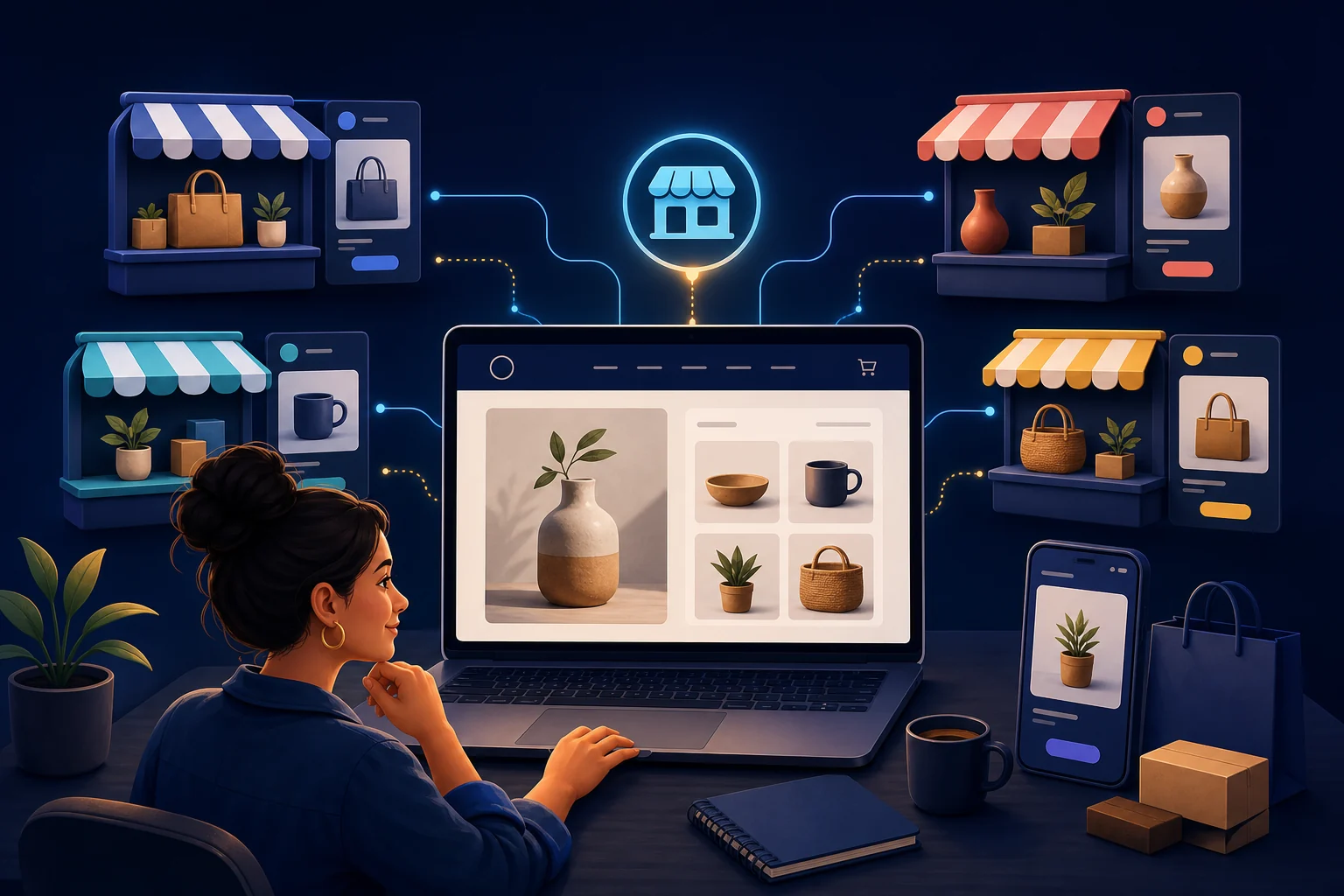
Marketplace sellers need their own website when the business is ready to become more than a listing inside someone else's shopping environment. The website creates a branded destination for independently earned traffic, deeper product information, direct customer journeys, and long-term growth—but it does not automatically replace marketplace discovery.
The short answer: build a business home, not just another listing
Amazon, eBay, Etsy, Walmart Marketplace, TikTok Shop, Facebook Marketplace, and other platforms can help sellers reach buyers quickly. That reach is valuable. It also happens inside a marketplace that controls the surrounding experience, seller requirements, ranking systems, fees, available features, and relationship with the shopper.
An independent website gives the seller a destination centered on its own brand. It can explain the company, organize products around the customer's needs, publish useful content, support direct campaigns, and create a consistent place for people who already know the business.
The goal is not necessarily to abandon every marketplace. It is to stop making one marketplace responsible for the entire future of the business.
Why marketplaces are useful
A marketplace may already have an audience, trusted checkout, familiar shopping patterns, seller reviews, advertising tools, customer-support systems, and operational features. For a new seller, that can lower the effort required to test products and complete early sales.
Marketplaces can be valuable for:
- Reaching shoppers who have never heard of the brand
- Testing which products, prices, images, and offers attract demand
- Using familiar checkout and marketplace trust
- Collecting operational experience before building a larger system
- Selling through an additional channel after an independent store launches
A strategy that recognizes those benefits is more credible than telling every seller to leave immediately. The question is whether the marketplace should remain the entire online business or become one channel within a broader system.
The limitations of marketplace-only selling
Your brand competes with the marketplace experience
Marketplace pages are designed to help shoppers find and compare products across many sellers. That can be excellent for discovery but limiting for differentiation. The marketplace's navigation, related listings, promotions, visual system, and policies surround the seller's content.
The rules and economics can change
Fees, ranking factors, advertising programs, listing requirements, supported product categories, fulfillment expectations, and seller standards can change. A healthy business reviews each platform's current terms instead of assuming today's operating model will remain unchanged.
Direct customer relationships may be limited
Marketplace rules and privacy obligations affect what customer information a seller can access and how it may be used. A seller should never assume marketplace buyers can be added to an outside marketing list. An independent website can provide its own transparent, permission-based signup experience for people who choose it.
One account can become a concentration risk
Technical problems, listing removals, policy reviews, verification issues, search changes, or account restrictions can interrupt sales. A website does not eliminate risk, but it gives the business another legitimate path to customers and revenue.
Comparison pressure can weaken positioning
When similar listings appear nearby, shoppers may compare primarily on price, delivery, ratings, or marketplace badges. A dedicated website has more room to explain materials, process, expertise, use cases, service, guarantees, product differences, and brand value.
What an independent website adds
| Business need | Marketplace-only approach | Independent website approach |
|---|---|---|
| Brand presentation | Presented within the marketplace's templates and environment | Dedicated domain, navigation, visual system, voice, story, and merchandising |
| Direct traffic | Often sent to a listing surrounded by competing options | Sent to a focused brand, collection, product, or educational page |
| Search content | Primarily listing and profile content | Products, collections, comparisons, guides, FAQs, stories, and support content |
| Audience building | Subject to marketplace data and communication rules | Permission-based email and other direct relationships established on the seller's property |
| Customer journey | Designed around marketplace shopping conventions | Designed around the brand's products, questions, offers, and purchasing path |
| Channel resilience | Revenue may depend heavily on one external account | Creates another route for independently acquired demand |
| Measurement | Limited to the platform's reports and permitted tools | Can connect store analytics, search data, campaigns, email, and business reporting |
The website should do more than display the same catalog in a different template. Its job is to help the business attract, educate, convert, retain, and learn from audiences it reaches independently.
“Your own website” does not mean complete ownership of every layer
The phrase normally means a store operating on the business's chosen domain with its own branding, content, catalog decisions, and direct customer journey. A Shopify merchant still depends on Shopify, payment providers, domain registrars, applications, email services, and applicable laws.
The most important assets to control are the domain registration, business accounts, original product content, approved customer data, brand files, product records, analytics access, and documented operating processes. Keep accounts in the business's name, use role-based access, and maintain usable exports or backups where the platform allows them.
Independence is not the absence of vendors. It is having intentional control over the brand, accounts, data, and customer paths that matter.
Signs a marketplace seller is ready for a website
Strong readiness signals
- Products have proven demand and predictable fulfillment
- People search for the business or product brand by name
- Traffic already comes from social media, search, events, referrals, creators, wholesale, or advertising
- Customers return, request additional products, or want a broader relationship with the brand
- The marketplace format cannot adequately explain the product or company
- The seller needs stronger collections, bundles, education, wholesale information, or support content
- Margins can support a store plan, payment processing, domain, marketing, and operations
- The business can maintain another catalog, order source, policy set, and customer-service channel
A seller does not need a huge audience. It needs validated products, organized materials, realistic operations, and at least one credible way to bring qualified visitors to the website.
When a seller should wait
A website will not fix an unproven product, unclear pricing, poor imagery, unreliable fulfillment, or nonexistent demand. Adding a storefront too early can divide limited attention across two systems.
- Wait if almost all demand comes from marketplace search and there is no independent traffic plan.
- Wait if product costs, marketplace fees, returns, shipping, and labor have not been included in margin calculations.
- Wait if quantities, descriptions, prices, policies, and messages cannot be kept accurate across channels.
- Wait if the business cannot provide usable product information and original images.
- Wait if the only goal is to avoid marketplace fees without accounting for website and customer-acquisition costs.
During that period, improve the current channel, organize product data, document fulfillment, strengthen the brand, and build an audience through methods that comply with marketplace rules and privacy requirements.
You can use Shopify and marketplaces at the same time
A marketplace can continue handling marketplace discovery while Shopify becomes the destination for traffic the seller generates independently. This reduces the pressure to make an immediate all-or-nothing decision.
Shopify's official migration documentation includes guidance for moving from platforms such as Amazon, eBay, Etsy, Square, Wix, WooCommerce, and others. Migration does not require deleting the original channel. The correct channel mix depends on profitability, customer acquisition, operational burden, and strategic value.
Give each channel a defined role
Decide which products, audiences, prices, promotions, fulfillment methods, and customer journeys belong in each location. Follow every marketplace's current policies; do not divert a marketplace-initiated transaction merely to avoid its fees.
Plan inventory and order control
Shopify's current Marketplace Connect documentation lists eligible connections for Amazon, eBay, Walmart in the United States, and Target Plus in the United States. It can synchronize supported products, listings, orders, and inventory. New Etsy connections are not currently supported through that app. Features, eligibility, and marketplace availability can change, so verify the live documentation before selecting a workflow.
Why Shopify can fit this transition
Shopify provides the connected system behind a direct online store: product catalog, collections, cart, checkout, payments, orders, discounts, customer records, shipping settings, content, reporting, themes, applications, and administrative controls.
That makes it a practical option for a seller who wants a new branded sales channel without assembling checkout, hosting, order management, and store administration from separate systems. It is not the only possible website platform, and it is not free to operate. Compare the actual business requirements before choosing.
Our Shopify versus regular website guide explains when a commerce-first platform fits better than a content-first business website.
The seller becomes responsible for traffic
A marketplace can place products in front of people already shopping. A standalone Shopify store does not arrive with that audience. The merchant must create demand through useful search content, social media, permission-based email, direct brand awareness, referrals, partnerships, events, creators, publicity, or paid campaigns.
Before building, answer:
- Who is the first specific audience for the website?
- Why would they visit the site instead of a marketplace listing?
- Which channel can repeatedly reach those people?
- What useful product, collection, comparison, gift, care, sizing, or buying content do they need?
- How will the business earn permission to communicate again?
- Which metrics will separate traffic, orders, profit, and repeat demand by source?
Do not treat paid advertising as the default solution. Confirm the store converts, margins can absorb acquisition costs, tracking works, and fulfillment is reliable before increasing spend.
A low-risk way to launch an independent store
- Keep productive marketplace listings active. Protect current discovery while the second channel is tested.
- Select a focused catalog. Begin with proven products rather than migrating every listing.
- Organize the foundation. Prepare product information, original images, brand assets, shipping decisions, policies, domain access, and business details.
- Define the website's job. Identify the audience, traffic source, offer, and reason the direct experience will be useful.
- Build and test. Check products, options, inventory, mobile usability, checkout, payment, tax, shipping, email, policies, accessibility, analytics, and customer support.
- Launch to an independently earned audience. Use channels the business controls or has permission to use.
- Measure before expanding. Compare conversion, contribution margin, acquisition costs, repeat purchasing, returns, support time, and operational errors.
Use our Shopify store launch checklist to review the full setup and testing process.
Where our free Shopify build fits
Overtime Innovations offers a new Shopify client-transfer store at no build fee for accepted US small businesses. The standard offer is designed to help a marketplace seller launch a focused independent store; it is not a complete large-catalog migration, advanced integration project, or promise of traffic or sales.
| Included in the standard offer | Not included by default |
|---|---|
| One separate new Shopify client-transfer store | Editing or rebuilding an existing Shopify store |
| Up to 10 products and 3 collections | A full marketplace catalog migration or cleanup |
| Basic launch copy and graphics using supplied business information and assets | Advanced branding, photography, inventory synchronization, or complex integrations |
| Typical delivery in 10–15 business days once required materials are ready | Guaranteed timing while materials, access, feedback, or approvals are missing |
| Typically up to 3 consolidated revision rounds | Unlimited revisions or ongoing redesign |
| 14 days of email-only support beginning on Day 0 | Ongoing management, marketing, fulfillment, or customer service |
The business remains responsible for Shopify, its domain, paid apps or themes, payment processing, inventory, shipping, tax, legal compliance, and all other third-party or operating costs. Review the complete free Shopify store launch offer before applying.
Frequently asked questions
Does every marketplace seller need a website?
No. New sellers may benefit from validating products and operations first. A website becomes more useful when demand, brand awareness, direct traffic, repeat purchasing, or customer-experience needs justify it.
Should I stop selling on marketplaces after launching?
Usually not immediately. Keep useful channels active while measuring whether the independent store attracts profitable demand and can be operated reliably.
Will Shopify automatically bring customers?
No. Shopify provides commerce infrastructure. The merchant remains responsible for generating traffic and earning customer trust.
Can Shopify connect to marketplace accounts?
Connections are available for certain marketplaces and eligible accounts. Support changes over time, so confirm the current Shopify and marketplace requirements before choosing a synchronization system.
Is a Shopify store completely independent?
No. The seller gains more control over the branded experience and direct customer journey but still relies on technology, payment, domain, and service providers.
Is the Overtime Innovations build really free?
The agreed standard build carries no build fee for accepted businesses. The merchant pays all platform, domain, app, theme, payment, product, fulfillment, tax, and operating expenses.
Build the channel your brand is ready to support
A marketplace can remain valuable, but it should not automatically define the complete brand, customer journey, or growth plan. When products are proven and the business can generate some demand independently, a focused Shopify store can become a practical next step.
Ready to create that next channel?
- Choose the ten products you would launch first
- Identify where the first qualified visitors will come from
- Prepare product, brand, policy, and fulfillment information
- Confirm that the standard free-build scope fits the business