
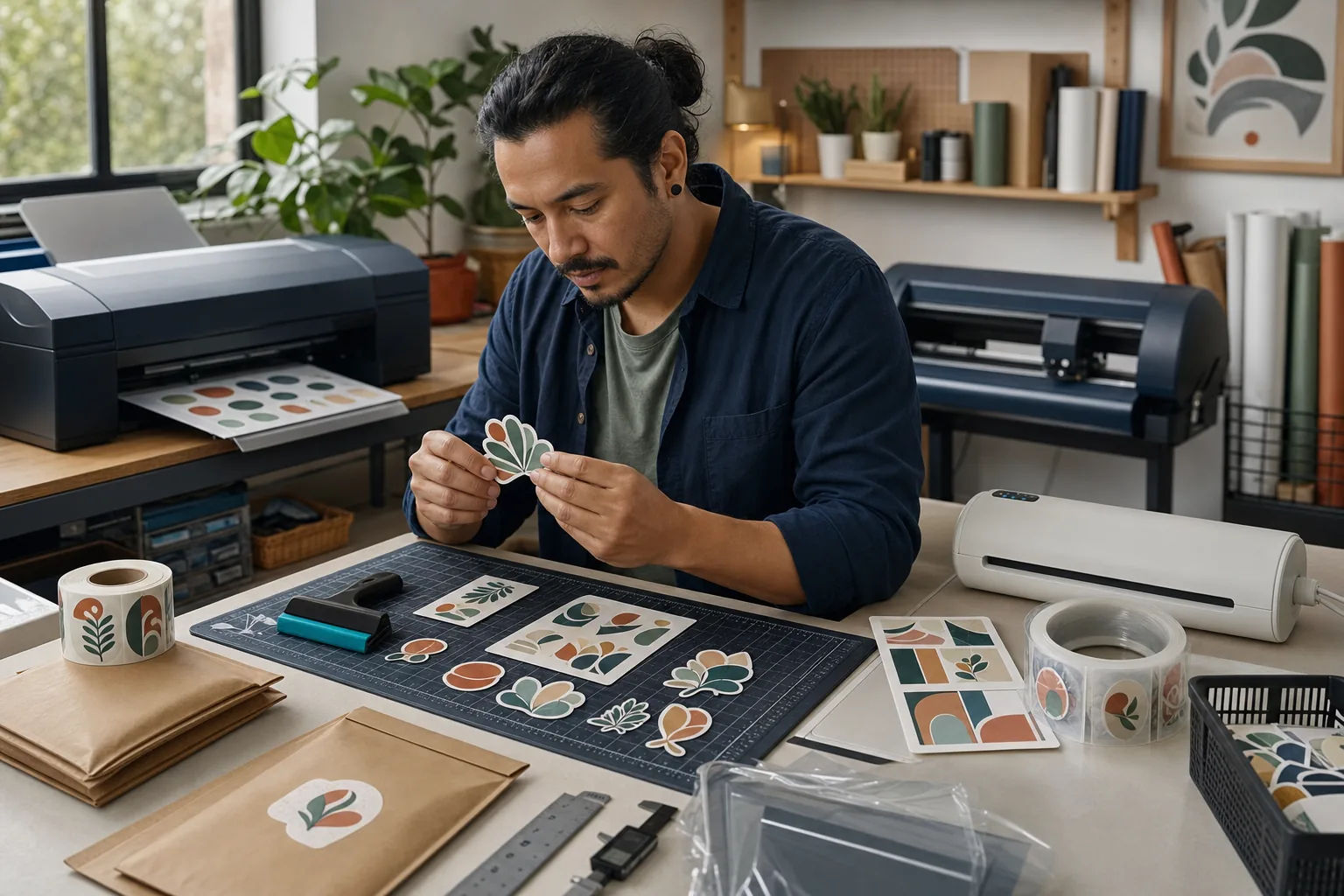
To sell custom stickers online successfully, establish who owns every design, separate ready-made products from true custom work, document the exact material and cut format, show finished size and finish accurately, support every durability claim, calculate the cost of the complete sheet and order, package for the chosen mail class, and build a repeatable path from approved artwork to final inspection and shipment.
The short answer: sell a defined physical product, not just an image
A buyer cannot judge adhesive, thickness, scale, edge quality, finish, opacity, backing, or color from artwork alone. The product page must translate a digital design into the physical item that will arrive.
A strong listing answers six questions immediately: What format is it? How large is it? What is it made from? What surfaces and conditions is it intended for? How many are included? When and how will it ship?
The design earns attention. The specification earns trust.
1. Choose the sticker business model before building the catalog
| Offer | What the buyer expects | Useful workflow |
|---|---|---|
| Original ready-made designs | A stocked design in a defined size, material, and finish | Standard product, accurate inventory, fast fulfillment |
| Made-to-order designs | A known design produced after purchase | Controlled options, production estimate, capacity limit |
| Personalized stickers | A name, date, color, or small approved change | Defined fields, character limits, proof rules, approval deadline |
| Customer artwork | Their supplied file reproduced to an agreed specification | File requirements, rights confirmation, review, proof, quote, approval |
| Business labels | Repeatable labels with consistent color, size, material, and quantity | Specification record, reorder path, batch control, wholesale terms |
| Print-on-demand | A third party produces and ships the item | Supplier integration, sample validation, margin and service plan |
One store can support several offers, but each needs a different promise. Do not sell an open-ended custom design project through a one-line personalization field. Do not call a third-party product handmade or in-house if that is not how it is produced.
2. Confirm the right to reproduce and sell every design
The U.S. Copyright Office's guidance for visual artists explains that original graphic artwork can receive copyright protection and that the owner controls making and selling copies. Use artwork you created, commissioned under appropriate written terms, licensed for the intended commercial use, or otherwise have permission to reproduce.
Keep an artwork record
- Creator, source file, creation or acquisition date, and version
- Written license or assignment and the uses, products, territories, and quantities it covers
- Fonts, stock assets, brushes, clip art, and generative tools used, with relevant terms saved
- Trademark review for names, logos, slogans, packaging, and designs that identify another business
- Customer confirmation that uploaded material can be legally reproduced and sold
- Approval history for any business logo, wedding design, school mark, or wholesale label
A checkbox is not a substitute for reviewing an obviously problematic upload. Popular characters, sports marks, brand logos, album art, celebrities, and copied marketplace designs may involve copyright, trademark, publicity, contract, or platform issues. Get qualified legal advice when rights are unclear.
3. Name the material, cut, finish, and format precisely
“Sticker” covers products that behave very differently. Paper labels for dry packaging, laminated vinyl decals, clear stickers, removable wall graphics, static cling, and roll labels should not share vague descriptions.
| Decision | Examples | What to explain |
|---|---|---|
| Format | Individual sticker, sticker sheet, label roll, decal, transfer graphic, pack | What arrives and how it is removed or applied |
| Cut | Kiss cut, die cut, contour cut, shape cut, sheet cut | Whether the liner remains around the sticker and what the finished edge follows |
| Face material | Paper, vinyl, polyester, clear film, specialty media | Manufacturer specification and intended use |
| Finish | Matte, gloss, holographic, metallic, clear, textured | Appearance, reflectivity, print limits, and care |
| Adhesive | Permanent, removable, repositionable, specialty | Supported surfaces, application, dwell time, and removal limits |
| Protection | Uncoated, varnished, laminated | What protection is applied and what it has actually been tested to withstand |
A kiss cut usually passes through the sticker face but leaves the surrounding liner intact. A die cut typically follows the finished shape through the face and backing. Terminology varies among equipment and suppliers, so show the back and edge rather than relying on the name alone.
4. Give every product a complete specification
Every sticker page should address:
- Finished width and height, preferably in inches and millimeters
- Whether measurements describe the sticker, sheet, or backing
- Quantity and whether a pack contains duplicates or different designs
- Face material, finish, opacity, adhesive type, liner, and protective layer
- Cut type, border appearance, corner shape, and transfer layer when present
- Recommended surfaces, preparation, application, cure or dwell time, and removal guidance
- Supported indoor, outdoor, water, UV, temperature, dishwasher, vehicle, or residue claims with conditions
- Color variation, white ink, clear areas, metallic effects, and screen-versus-print limitations
- Ready-to-ship or made-to-order status and realistic processing time
- Packaging, shipping method, tracking availability, returns, and damage reporting
Do not publish a media thickness, adhesive specification, service temperature, or expected life by guessing from a supplier category. Save the current technical data for the exact media, ink, laminate, printer, and process being used.
5. Photograph scale, finish, cut, backing, and application
Shopify supports product images, video, and other media, and its current product-media guidance emphasizes helping customers understand product size and quality. For stickers, a useful gallery includes more than an enlarged artwork file.
- Primary view: The complete physical sticker or sheet against a neutral surface
- Scale: A ruler, hand, notebook, bottle, laptop, or other clearly identified reference
- Finish: Angled lighting that honestly shows matte, gloss, clear, metallic, or holographic behavior
- Edge and liner: A close image showing border, cut path, backing, and peel tab if present
- Applied view: The actual product on a tested representative surface
- Pack contents: Every included design and the total quantity
- Packaging: What protects the order in transit
Label digital mockups as mockups and support them with photos of the produced item. Keep white balance and exposure consistent. A tiny sticker enlarged to fill the frame without scale information creates the wrong expectation.
6. Use variants for controlled choices, not open-ended production
Shopify's current variant guidance lets one product represent combinations such as size and finish, with inventory managed for each variant. Keep combinations understandable and make sure each selectable option can actually be produced, priced, photographed, and stocked.
A ready-made sticker might use size and finish variants. A pack might use quantity tiers. If every size changes the art, cut path, material yield, price, and photograph, separate products may be clearer than an enormous variant matrix.
Personalization needs its own rules
- State exactly what can change and what remains fixed.
- Set character, line, color, language, and file-type limits.
- Explain whether a proof is included, how it is delivered, and the response deadline.
- Define what counts as one revision and when production becomes irreversible.
- Do not rely on order notes for complex custom art, variable quantities, or uncertain files.
7. Build a repeatable print-and-cut quality standard
Customers compare the delivered piece with the product image, not with the operator's intention. Define acceptable registration, contour accuracy, color, banding, lamination, edge lift, scratching, bubbles, dust, backing cuts, sheet alignment, and count.
Useful controls
- Save an approved master file and cut path.
- Confirm color mode, resolution, bleed, safety area, white layer, and transparency.
- Record printer, media, ink, profile, laminate, blade, pressure, speed, and pass settings.
- Print a controlled sample when material or settings change.
- Allow required drying, curing, or outgassing time before lamination or cutting.
- Inspect registration and edge quality across the sheet, not only the first piece.
- Count, clean, package, and record the finished batch.
“High quality” is too vague to operate. A written tolerance and a retained approved sample help a small shop make consistent decisions when a piece is borderline.
8. Test durability claims under the conditions customers will understand
The FTC's advertising substantiation policy says objective product claims need a reasonable basis before they are advertised. Terms such as waterproof, weatherproof, UV resistant, fade resistant, dishwasher safe, removable, residue free, scratch resistant, vehicle safe, and outdoor life expectancy are objective claims.
Test the complete construction—not merely the face film. Media, ink, overlaminate, cut edge, adhesive, surface, preparation, application, dwell time, sunlight, water pressure, detergent, heat, abrasion, and duration can change the result.
A useful claim states:
- The exact product construction evaluated
- The surface and preparation used
- The exposure, temperature, duration, cycles, and evaluation criteria
- Important exclusions, such as textured, dirty, flexible, freshly painted, low-energy, or food-contact surfaces
- Whether the statement comes from your testing, a qualified lab, or a component supplier
If the evidence only supports occasional splashes, say that. Do not translate a supplier's rating for unprinted film into a broader promise about a finished sticker.
9. Price the whole order, including the failures
Material by the square inch is only one cost. A sustainable price includes artwork and preflight, setup, test prints, media, ink or toner, laminate, liner, cutting, weeding, sorting, failed sheets, color calibration, maintenance, labor, equipment, software, packaging, postage handling, selling and payment costs, customer service, overhead, risk, and profit.
Separate these calculations
- Single stickers: High pick, pack, and transaction cost relative to the item
- Packs: Better order value but more assembly and inventory coordination
- Sheets: Efficient handling when artwork and cut paths are repeatable
- Personalized orders: File review, proofing, revision, and setup time
- Wholesale or business labels: Quantity discounts based on real setup and run savings
Use a minimum order, pack, or shipping threshold when a one-dollar item cannot carry the labor of an individual shipment. “Free shipping” still has a cost and should be modeled in product prices, thresholds, or marketing expense.
10. Track sellable finished goods and production capacity
Shopify inventory represents the quantity available for each product or variant. Track finished, inspected stickers as sellable inventory; keep unprinted media, work in progress, seconds, samples, reserved wholesale stock, and damaged goods separate.
For made-to-order products, unlimited inventory can create more work than the shop can complete. Set order limits around printer time, drying or curing, lamination, cutting, inspection, personalization, packing, and existing wholesale commitments. Publish a realistic processing window and update it before a promotion or launch.
Record batches when a media, ink, laminate, profile, or supplier change could affect color and durability. If a customer reorders business labels, the previous order specification and retained sample should make “same as last time” measurable.
11. Use bundles to improve value without confusing the contents
Theme packs, seasonal sets, mystery assortments, collector releases, sample kits, and coordinated labels can raise order value and reduce the burden of shipping a single sticker. Show every included design unless surprise is the actual, clearly disclosed product.
Shopify's current bundle guidance notes that bundles require a bundle solution. Validate component inventory, discounts, returns, and fulfillment before relying on automation. A manually defined pack may be easier for a small launch.
Subscriptions can work for a business with a reliable release schedule and enough design demand, but they add renewal communication, skipped payments, address changes, cancellation, inventory, and customer-service obligations. They are not necessary for proving the first collection.
12. Match packaging to the exact mailpiece—not the product's low weight
Stickers can be inexpensive to mail, but bending protection, thickness, rigidity, tracking, international documents, and customer expectations affect the service that fits. The current USPS Domestic Mail Manual contains physical standards for letters, flats, and parcels. A rigid or unusually shaped mailpiece may not qualify for the same processing or price as a flexible letter.
Compare two common approaches
| Approach | Advantage | Tradeoff to plan for |
|---|---|---|
| Light envelope or mailer | Lower material and possible postage cost | Less protection, limited or no tracking, machinability rules, greater support uncertainty |
| Rigid or tracked package | More protection and clearer shipment events | Higher cost that can overwhelm a small order |
Test the final sealed package with the actual carrier or postal guidance before publishing a rate. Do not promise tracking, letter pricing, or machinability merely because a sample envelope is light. Photograph the packaging standard and define when larger orders upgrade to a different service.
13. Separate production defects from application failures
Define how customers report missing pieces, wrong items, visible print or cut defects, transit damage, and non-delivery. Ask for useful photographs without turning every request into an interrogation. State the reporting window, remedy, and whether packaging must be retained.
For application problems, instructions matter. Specify suitable surfaces, cleaning method, drying, temperature, pressure, dwell time, transfer technique, and removal. Avoid blaming the buyer when the listing never disclosed a surface limitation.
Personalized and custom products may need different return terms, but those terms should be shown before purchase and should not erase remedies for errors, defects, or applicable consumer rights. Keep a root-cause log so replacements lead to process improvements.
14. Build a quote path for wholesale and complex custom work
Business labels, event stickers, packaging seals, artist collaborations, and retail packs can become repeat work. They also introduce file review, brand color, proof approval, quantity breaks, production tolerances, deadlines, freight, resale paperwork, and payment terms.
A useful inquiry captures:
- Contact and business information
- Intended use and application surface
- Finished size, shape, quantity, material, finish, and packaging
- Artwork status, file format, white ink or special-layer requirements, and rights confirmation
- Color expectations and whether a physical proof is required
- In-hand date, destination, delivery method, and split shipments
- Repeat-order expectations and requested payment terms
Review feasibility before taking irreversible payment. Use a written specification, quote, proof, approval record, and production version. A consumer product page is not a substitute for a controlled business-order process.
15. Connect the order to a production traveler
A clean workflow reduces wrong sizes, old artwork, mismatched finish, missing pieces, and rushed shipping.
- Capture the order, variant, personalization, delivery promise, and customer contact.
- Preflight artwork and confirm reproduction rights.
- Resolve questions and issue a proof when the product requires one.
- Lock the approved art, specification, quantity, and due date.
- Schedule print, cure or dry, laminate, cut, weed, and finishing steps.
- Inspect against the approved sample and tolerance.
- Count and package the correct products.
- Purchase the validated shipping service and send accurate tracking information when available.
- Record the batch, actual time, waste, defect, replacement, and margin data.
Keep customer-supplied files out of public storefront file storage. Shopify warns that files uploaded to its general Files area are intended for public access, so sensitive or customer artwork needs an appropriate controlled workflow.
16. Market the use case and craft without borrowing someone else's audience
Build collection pages around real demand: laptop stickers, planner sticker sheets, packaging labels, water-bottle decals, wedding labels, artist sticker packs, business logo stickers, or custom short runs—only where the product is actually suitable for that use.
Product titles should combine the design or purpose with meaningful format details. Descriptions should answer size, material, finish, quantity, application, durability, production, and shipping questions in plain language. Image alt text should describe the physical product rather than repeat keyword variations.
Content that can earn qualified traffic
- Kiss-cut versus die-cut stickers with real examples
- How to choose sticker size for packaging or products
- Matte versus gloss finish for a specific application
- How to prepare artwork, bleed, borders, and cut paths
- How to apply and remove the exact material you sell
- Behind-the-scenes production, testing, packing, and business reorders
Collaborations, local retailers, event organizers, packaging designers, and complementary makers can create referral traffic and legitimate links. Use original designs and transparent relationships rather than copying a trending character or competitor listing.
17. Launch a small collection the shop can fulfill well
Before opening checkout:
- Choose up to ten defined products with controlled variants
- Confirm artwork rights and save source records
- Document material, adhesive, cut, finish, size, quantity, and claims
- Photograph the produced product, scale, finish, backing, application, and packaging
- Calculate sustainable prices for singles, packs, custom work, and wholesale
- Test the complete production and inspection process
- Package and mail test orders using the exact intended service
- Write application, processing, shipping, damage, return, and custom-order terms
- Test product selection, discounts, checkout, taxes, notifications, inventory, and mobile display
- Prepare support answers for surface suitability, tracking, late mail, and replacements
Launch with fewer formats if necessary. A reliable paper sticker, laminated decal, and coordinated pack are more useful than twenty listings whose materials and promises are uncertain.
18. What the free Shopify build can cover
For accepted US small businesses, Overtime Innovations can build one new Shopify client-transfer store at no build fee. The standard scope includes up to ten products, up to three collections, and basic launch copy and graphics prepared from the materials the business supplies.
The typical build takes 10–15 business days once the required materials are ready, generally includes up to three consolidated revision rounds, and comes with 14 days of email-only post-launch support beginning on Day 0. The business remains responsible for its products, artwork rights, claims, pricing, policies, customer service, and legal or professional advice.
Outside the standard free scope
- Work inside an existing Shopify store
- Advanced customer artwork uploads or file processing
- Live design previews, configurators, or automated quote engines
- Print-on-demand, fulfillment, shipping, accounting, or production integrations
- Subscriptions, complex personalization, wholesale portals, or B2B systems
- Custom applications, premium themes, paid apps, product testing, or compliance work
The owner pays Shopify plan charges, domain costs, payment processing, themes or apps they choose, production equipment and materials, packaging, shipping, taxes, insurance, and other third-party expenses.
Frequently asked questions
Is Shopify good for selling custom stickers?
It can be a strong branded home for a sticker business that is ready to generate its own traffic, maintain product information, and fulfill orders consistently. A marketplace can still remain one of several sales channels.
What belongs on a sticker product page?
Include the format, finished dimensions, quantity, material, finish, cut, adhesive and liner, intended surfaces, supported durability claims, production time, packaging, shipping, and return or replacement terms.
What is the difference between kiss cut and die cut?
A kiss cut generally cuts the sticker face while leaving a larger liner intact. A die cut generally follows the final shape through both sticker and backing. Show photographs because supplier terminology and finished formats can differ.
Can I print customer artwork or popular characters?
Only reproduce artwork you own or have permission to use for the intended commercial purpose. Customer terms, review, written licenses, and qualified legal advice may be needed; recognizable brands and characters can also raise trademark and other issues.
How should I price custom stickers?
Include the complete order cost: artwork, preflight, setup, printing, media, ink, laminate, cutting, waste, labor, equipment, software, packaging, postage handling, fees, service, overhead, risk, and profit.
Can Overtime Innovations build the store for free?
The standard offer covers one new Shopify client-transfer store with up to ten products and three collections for an accepted US small business. Advanced upload, preview, quote, subscription, wholesale, integration, and existing-store work are outside that scope.
Make the physical specification as memorable as the artwork
A sticker store earns repeat orders when customers receive the size, finish, color, durability, quantity, and delivery experience they expected. Make every product repeatable before making the catalog bigger.
Ready to prepare the first collection?
- Select up to ten clearly defined sticker products
- Document artwork rights, specifications, claims, production, and pricing
- Prepare accurate photographs, packaging, shipping, and policies
- Confirm that the standard build fits without advanced customization or integrations